F1 Goldendoodle Guide: Coat, Size, Shedding, Temperament & Puppy Truths
Picking a Goldendoodle puppy is exciting, but the generation terms can feel confusing at first.
The F1 Goldendoodle is one of the most loved choices because it has the classic Doodle look, a friendly personality, and a balanced mix of traits. Still, every puppy can be a little different. Some have loose waves. Some look shaggy. Some shed more than expected, and some grow bigger than planned.
This guide explains the F1 in simple terms, including coat, shedding, allergies, grooming, size, and temperament, so you can choose with confidence.
What Is an F1 Goldendoodle?
The simple meaning of F1 genetics
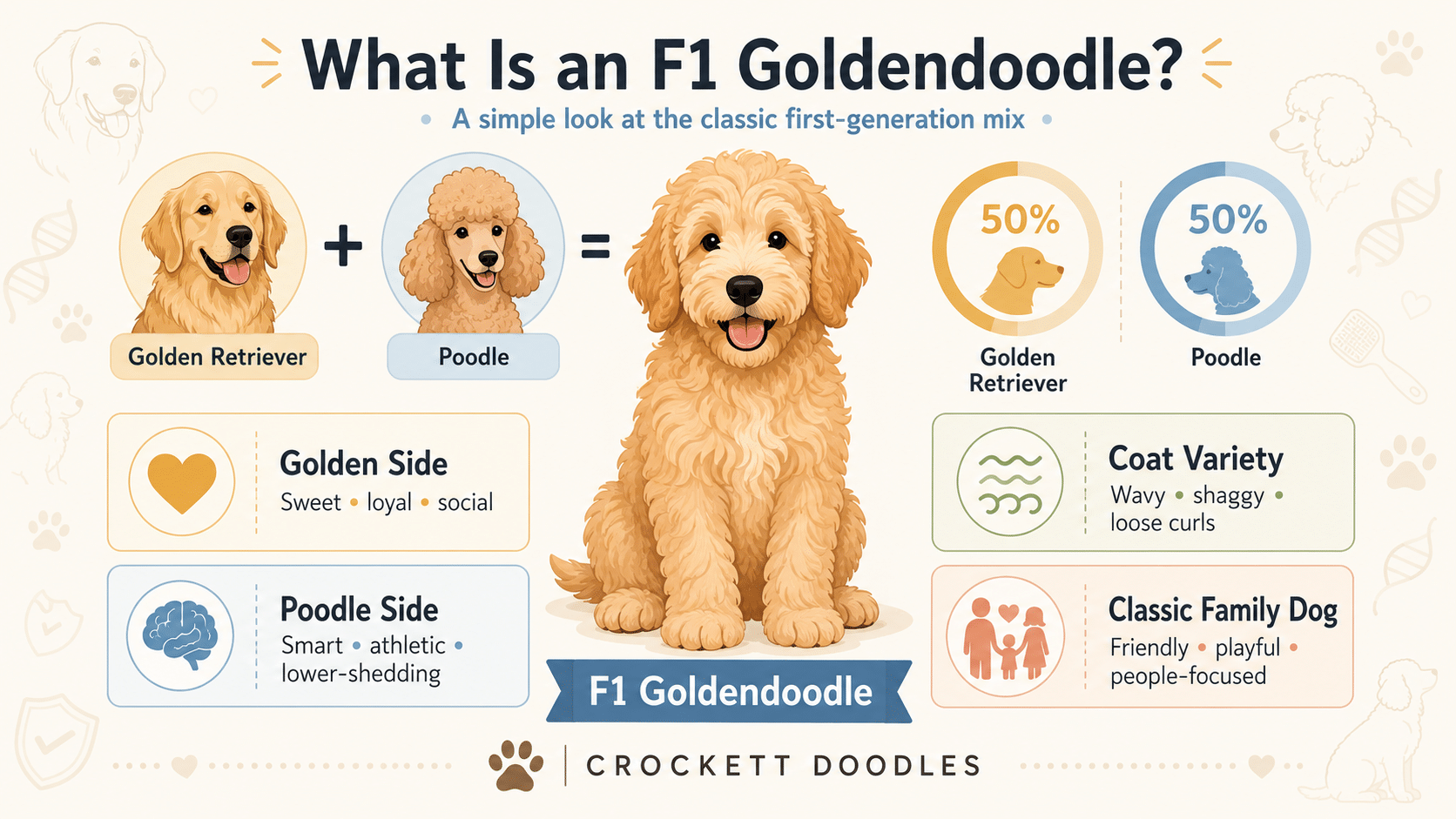
An F1 Goldendoodle is a first-generation mix between a purebred Golden Retriever and a purebred Poodle. The “F” refers to a crossbred generation, and the “1” means it is the first generation.
In simple words, the Goldendoodle F1 is 50 percent Golden Retriever and 50 percent Poodle.
That balance is the main appeal. The Golden Retriever side may bring loyalty, warmth, and a people-loving nature. The Poodle side may add intelligence, athletic energy, and a coat that often sheds less than a Golden Retriever’s.
A simple way to picture the mix
Think of puppy genetics like a recipe.
The Golden Retriever side may bring sweetness, loyalty, and a social nature. The Poodle side may bring intelligence, focus, curl, and lower shedding.
Each F1 Goldendoodle puppy gets both sets of traits, but not in the same way. One may look loose and shaggy. Another may have tighter waves or more Poodle-like coat texture.
That variety is part of their charm, but it also makes clear expectations important before choosing.
At a Glance
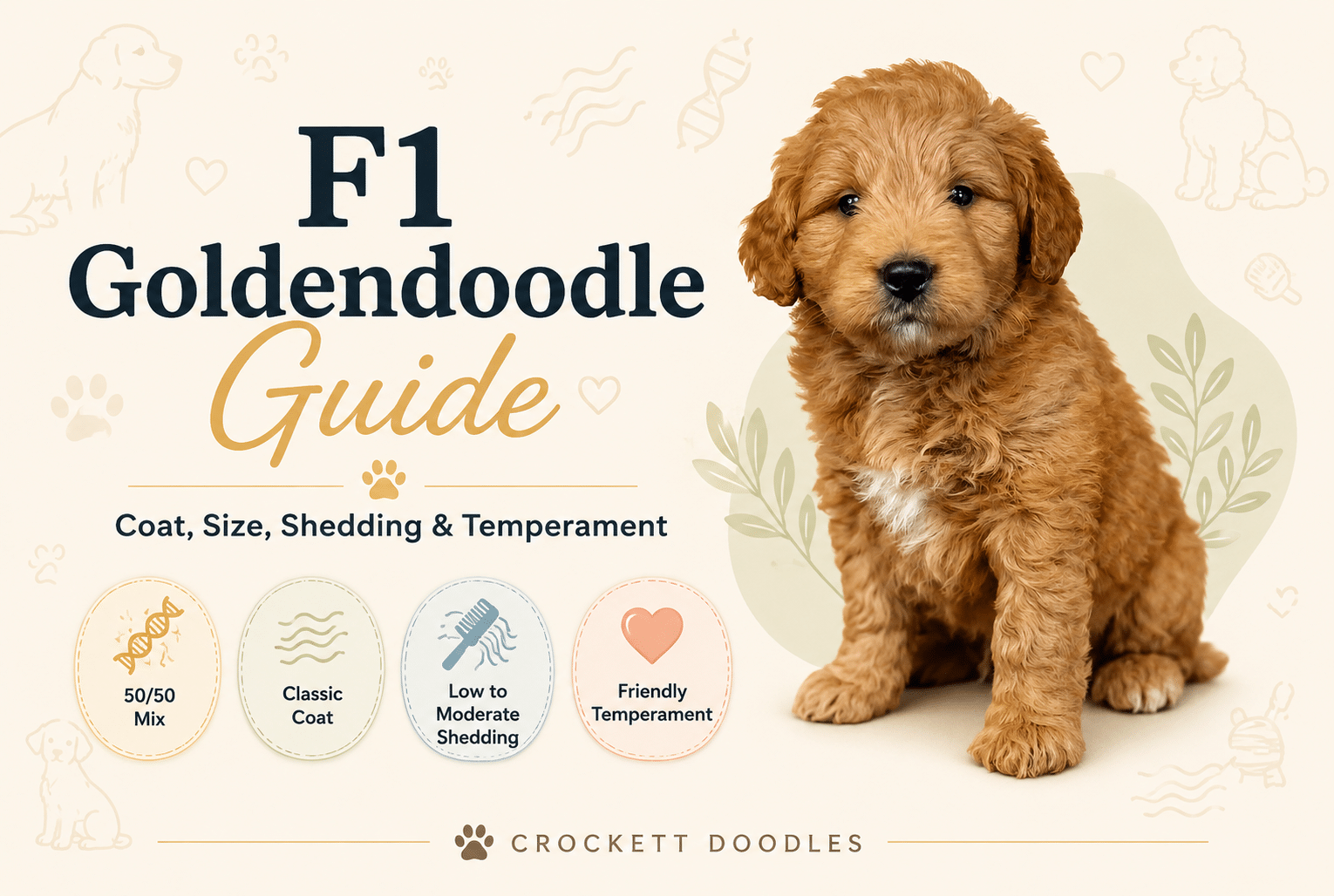
F1 Goldendoodle at a Glance
A quick overview of the classic first-generation Goldendoodle.
Genetics
50% Golden Retriever and 50% Poodle
Coat
Wavy, shaggy, loose curls, or sometimes straighter
Shedding
Low to moderate
Allergy Friendly
May work for mild allergies, but not guaranteed
Grooming
Regular brushing and professional trims
Temperament
Friendly, playful, smart, and people-focused
Best For
Families who want the classic Goldendoodle personality and look.
Less Ideal For
Homes needing the most predictable low-shedding coat.
The quick takeaway
The F1 Goldie is a great fit for families who want a classic, friendly Doodle and are comfortable with some coat variety.
If very low shedding is your top priority, an F1B or multigen may be a better match. But if you love the natural shaggy look and want a sweet, social family dog, the F1 can be a wonderful choice.
F1 Goldendoodle Coat Type and Shedding
Why coats can look different
The coat is one of the first things people notice.
It is also one of the least predictable parts of this generation.
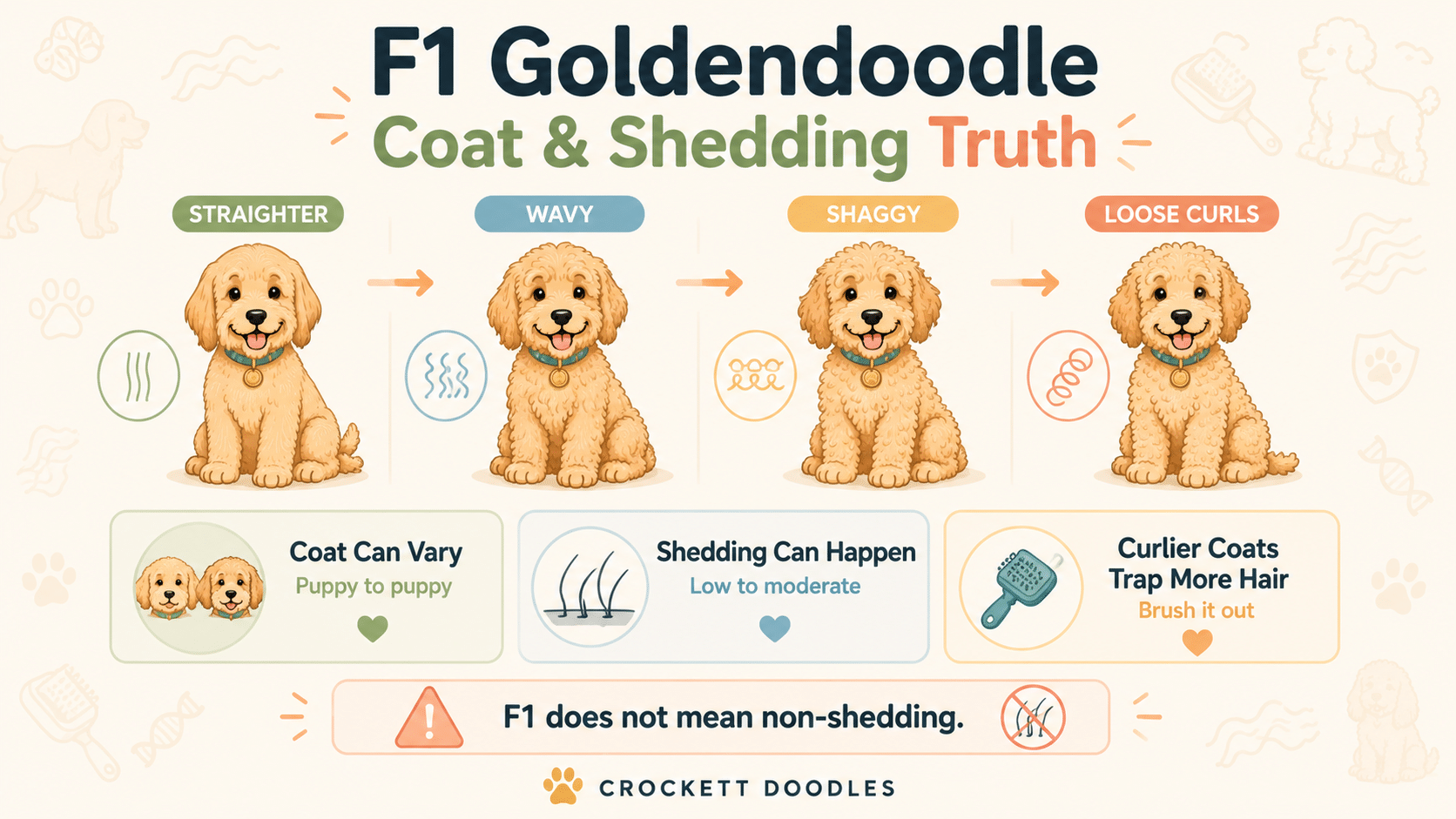
Because an F1 Goldendoodle is half Golden Retriever and half Poodle, the coat can land in different places. Some puppies have soft waves. Some have a shaggy teddy-bear look. Some have loose curls. Others may have a straighter coat that leans more toward the Golden Retriever side.
This happens because coat genes do not follow a perfect pattern.
The Poodle side often brings curl and lower shedding. The Golden Retriever side can bring a smoother coat and more loose hair. When those traits mix, every puppy can be a little different.
This is why experienced F1 Goldendoodle breeders are helpful. They can look at the parent dogs, past litters, and puppy coats to give you a better idea of what may happen.
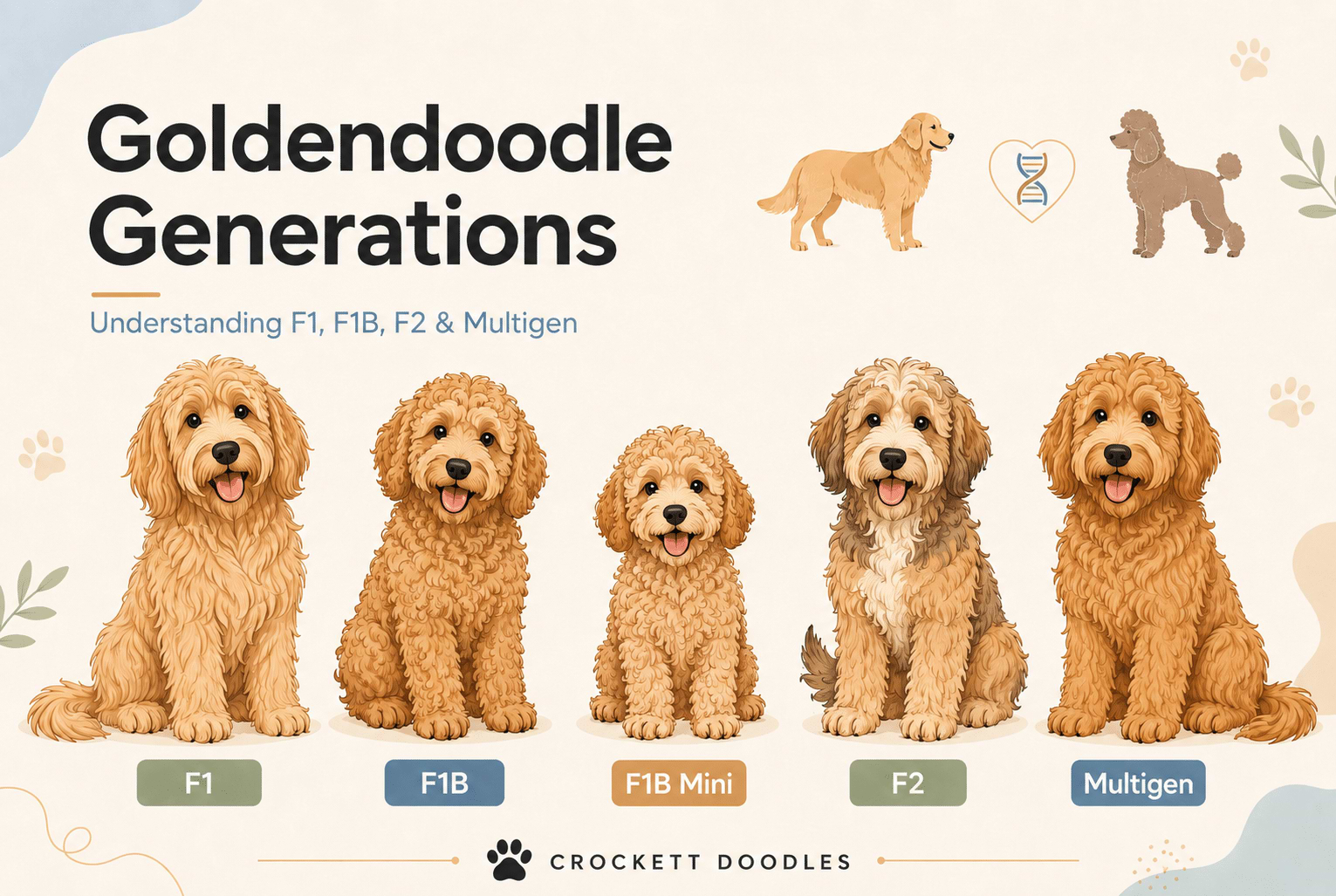
Also Read: Goldendoodle Coat Types: Complete Guide to Every Coat
Do F1 Goldendoodles shed?
Yes, they can shed.
The honest answer is that F1 Goldendoodles are often low-shedding, but they are not always non-shedding.
Some shed very little. Others leave more hair around the house, especially if the coat leans toward the Golden Retriever side. A curlier or more furnished coat may trap loose hair better. A flatter coat may release more hair.
That does not mean anything is wrong with the puppy. It is just genetics.
If you want an F1 Goldendoodle for sale and shedding matters to your family, ask direct questions. Ask about the parents’ coats. Ask about past puppies. Ask whether the breeder has seen low-shedding results in similar pairings. A good breeder will be honest, not make perfect promises.
Are F1 Goldendoodles Hypoallergenic?
What allergy-friendly really means
Many families ask, “are F1 Goldendoodles hypoallergenic?”
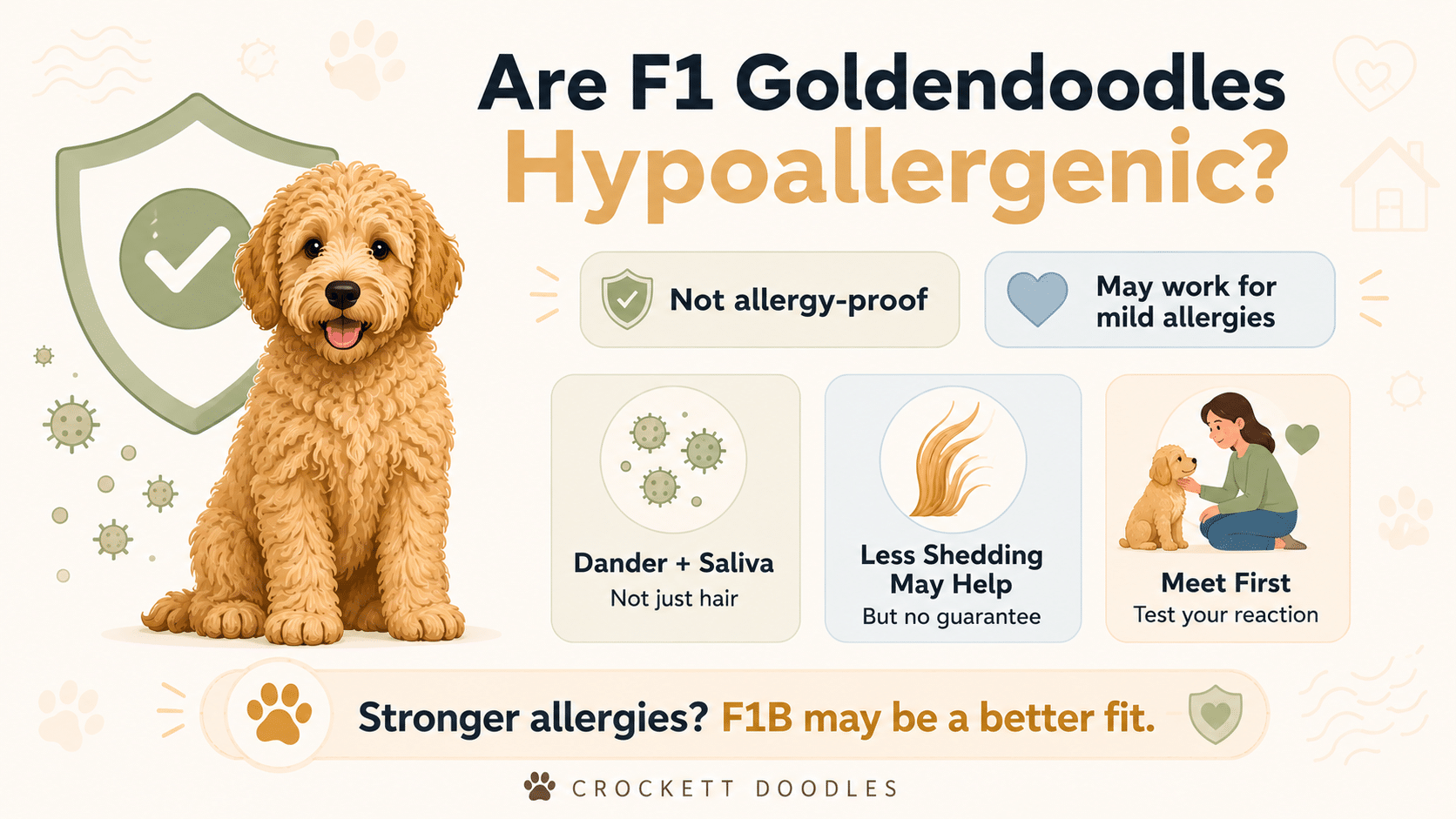
The truthful answer is no dog is fully hypoallergenic.
All dogs produce proteins in their saliva, skin, and dander that can trigger allergies. Hair matters, but it is not the only factor. When a dog sheds less, there may be less dander moving around the home. But that does not remove the allergy risk completely.
The F1 may work well for some people with mild allergies. Other families may still react.
This is why the word hypoallergenic should be used carefully. It can mean “better for some allergy-sensitive homes,” but it should not mean “allergy-proof.”
How to make a safer choice
If allergies are a concern, try to spend time with the puppy before making a final decision.
A short visit can help. A longer visit is better. Some reactions do not happen right away.
If your allergies are serious, the F1 may not be the safest generation. A curlier F1B or multigen puppy may offer more predictability.
Still, every person reacts differently. Your own body gives the most honest answer.
F1 Goldendoodle Grooming Needs
Brushing and coat care
They needs regular grooming, even when the coat looks easy.
That soft coat can hide small tangles near the skin. These tangles can turn into mats if they are ignored. Mats can pull on the skin and make the dog uncomfortable.
Most F1 dogs need brushing several times each week. A loose wavy coat may be easier. A thicker or curlier coat may need more work.
The most common trouble spots are behind the ears, under the collar, around the legs, near the tail, and under the belly.
It helps to start brushing when the puppy is young. When grooming feels normal early, it becomes much easier as the dog grows.
Professional grooming
Most F1 need professional grooming every six to eight weeks.
This keeps the coat at a healthy length and prevents painful matting. It also helps with nails, paws, ears, and sanitary areas.
Many families love the fluffy look, but that look takes care. A beautiful coat does not stay beautiful on its own.
Grooming is not just about style. It is part of keeping your dog comfortable.
F1 Mini Goldendoodle vs Standard F1 Goldendoodle
An F1 mini Goldendoodle and a standard F1 are both first-generation mixes. The main difference is the size of the Poodle parent.
| Feature | F1 Mini Goldendoodle | Standard F1 Goldendoodle |
|---|---|---|
| Parent Mix | Golden Retriever + Miniature Poodle | Golden Retriever + Standard Poodle |
| Genetic Blend | 50% Golden Retriever / 50% Poodle | 50% Golden Retriever / 50% Poodle |
| Size | Smaller, but not always tiny | Larger and stronger-bodied |
| Best For | Smaller homes, townhouses, families wanting an easier-to-manage size | Active families, larger homes, outdoor play, and longer walks |
| Energy Level | Still active and playful | Usually active and athletic |
| Important Note | “Mini” does not always mean calm or low-energy | Needs space, exercise, and regular activity |
A full grown F1 can vary in size, so parent size is the best clue. When looking at F1 Goldendoodle puppies, ask how big the parents are and how large past puppies from similar pairings became. This gives you a better idea than guessing from puppy size alone.
F1 Goldendoodle Temperament and Training
What the personality is usually like
The F1 Goldendoodle temperament is one of the biggest reasons families love this mix.
These dogs are often social, affectionate, playful, and eager to be near people. They usually enjoy being included in daily routines. Many follow their owners from room to room because they like connection.
The Golden Retriever side often brings warmth and patience. The Poodle side often brings intelligence and quick learning.
Together, this can create a dog that is both sweet and smart.
That sounds perfect, but smart dogs still need direction. Without training, they may create their own entertainment. That can mean jumping, chewing, digging, or stealing socks. And that is not really bad behavior. It is often boredom.
Training early makes life easier
Early training helps your puppy understand the rules of your home.
Simple lessons make a big difference:
- Where to potty
- How to sleep in a crate
- How to walk on a leash
- How to greet people calmly
- How to be alone for short periods
- How to settle after playtime
Short, positive sessions usually work best. These dogs often want to please, but they can get excited. Calm repetition helps. Socialization also matters. Let your puppy meet safe people, hear normal home sounds, see new places, and learn that the world is not scary.
A well-trained F1 Goldendoodle adult is usually a joy to live with. The puppy stage takes effort, but that effort shapes the dog you will have for years.
F1 Goldendoodle Health and Hybrid Vigor
What hybrid vigor means
Many families like the F1 Goldendoodle because of hybrid vigor. This means mixing two different breeds may support stronger genetic diversity and reduce the chance of some inherited issues.
Still, hybrid vigor is not a guarantee. An F1 puppy can inherit health concerns from either parent breed.
Why breeder quality matters
Generation alone does not make a puppy healthy.
Good F1 Goldendoodle breeders focus on parent health, temperament, structure, coat, and early puppy care. When searching for an F1 Goldendoodle for sale, ask about health screening, parent dogs, and how the puppies are raised.
A trusted breeder wants the puppy to fit your family, not just leave quickly.
Who Is an F1 Goldendoodle Best For?
Best homes for this generation
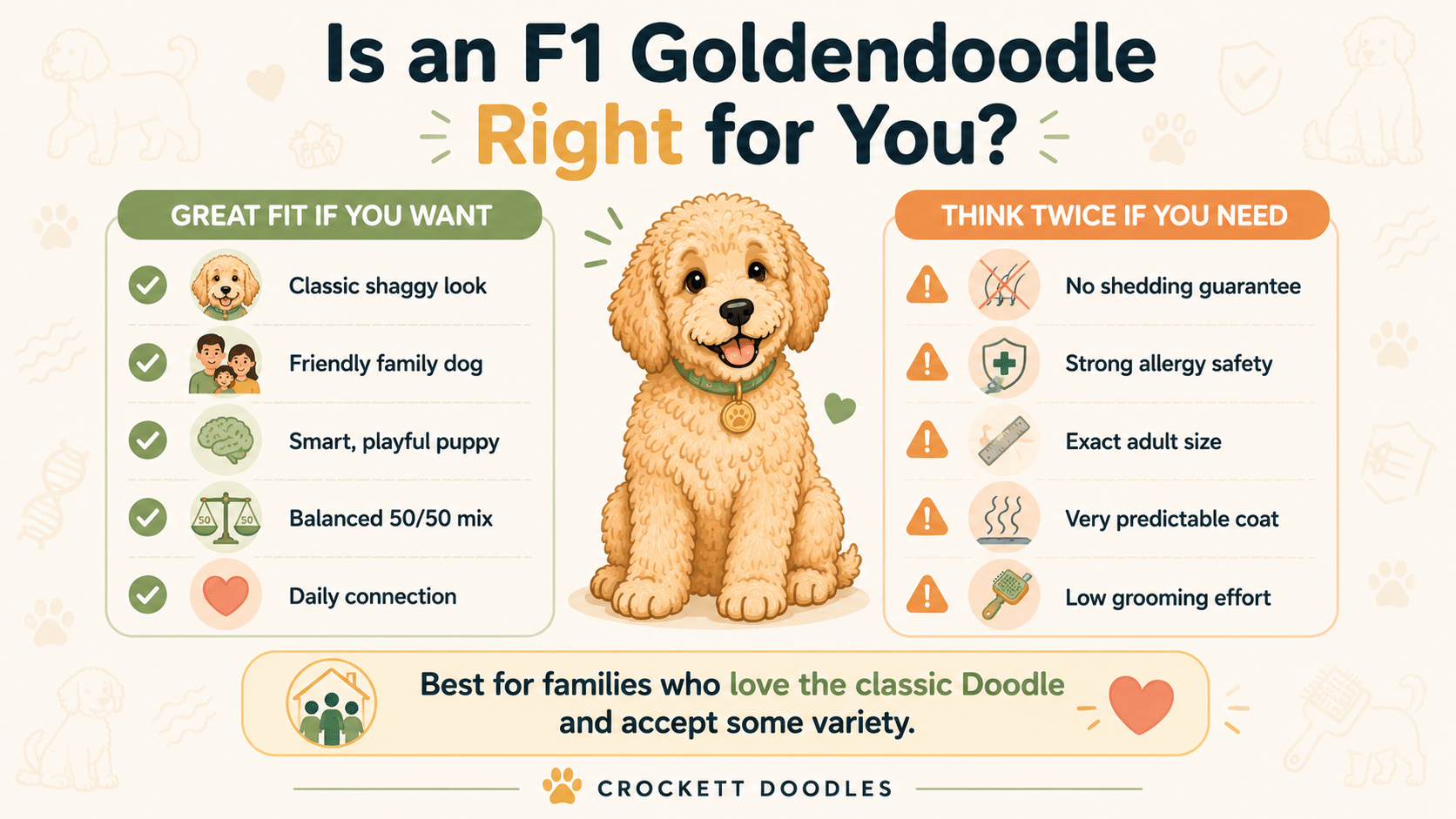
The F1 Goldendoodle is often a great fit for families who want a friendly, playful, classic Doodle and do not need a perfectly predictable coat.
This generation may be right for you if you:
- Like the shaggy Goldendoodle look
- Are okay with possible light shedding
- Have time for brushing and grooming
- Want a social family dog
- Enjoy training and daily activity
- Do not need the strongest allergy-friendly option
It can be a beautiful match for homes that want connection. These dogs often want to be involved, loved, and included.
When another generation may be better
Another generation may be better if allergies are a major concern or if you want the lowest possible shedding.
An F1B or multigen Goldendoodle may offer more coat predictability. That can matter for allergy-sensitive homes or families who want a curlier coat.
The right choice depends on your life.
Think about your home, schedule, grooming budget, allergy needs, and activity level. A puppy should fit your daily life, not just your favorite photo.
Finding F1 Goldendoodle Puppies
When looking for F1 Goldendoodle puppies, focus on health, temperament, and breeder care first.
At Crockett Doodles, we raise family-raised, healthy, well-socialized F1 Goldendoodle puppies with family fit in mind. Our goal is to help each puppy go to a home where they can thrive.
Many of our puppies are also ready to pick up, which makes the process easier for families who are prepared to bring home their new companion.
Red flags to avoid
Be careful with sellers who promise every F1 Goldendoodle will be fully hypoallergenic, completely non-shedding, or an exact adult size. Those promises are not realistic.
Also avoid breeders who rush your decision, avoid questions, or focus only on payment. A trusted breeder cares where the puppy goes.
FAQs About F1 Goldendoodles
What is an F1 Goldendoodle?
An F1 Goldendoodle is a first-generation mix between a Golden Retriever and a Poodle. It is usually 50% Golden Retriever and 50% Poodle.
Are F1 Goldendoodles hypoallergenic?
F1 Goldendoodles may be better for some mild allergy concerns, but they are not fully hypoallergenic. No dog is completely allergy-free. People with stronger allergies may prefer an F1B or multigen Goldendoodle.
Do F1 Goldendoodles shed a lot?
Most F1 Goldendoodles are low to moderate shedders. Some shed very little, while others shed more if their coat leans toward the Golden Retriever side. Coat type makes a big difference.
How big is a full grown F1 Goldendoodle?
A full grown F1 depends on the size of the Poodle parent. Mini F1 Goldendoodles are smaller, while standard F1 Goldendoodles can grow much larger. Parent size is the best clue.
Is an F1 mini Goldendoodle good for apartments?
An F1 mini Goldendoodle can work well in an apartment if the dog gets enough exercise, training, and attention. Smaller size helps, but these dogs still need daily movement and mental activity.
Conclusion: Is an F1 Goldendoodle Right for Your Family?
The F1 Goldendoodle is a loving, classic, first-generation Doodle with a lot to offer.
This mix can bring together the sweet heart of a Golden Retriever and the bright mind of a Poodle. Many families love the friendly nature, soft coat, and playful personality.
Still, the F1 comes with variety. Coat, shedding, size, and allergy-friendliness can differ from puppy to puppy. That is why learning before choosing matters so much.
If you want a balanced family dog and are comfortable with grooming, activity, and some coat unpredictability, this generation may be a wonderful fit.
Better expectations lead to better choices. And better choices lead to a happier life with your dog.
Ready to bring a classic, family-raised F1 into your home? Browse our available F1 Goldendoodle puppies to find the perfect, healthy match for your family today.
are f1 goldendoodles hypoallergenic, F1 Goldendoodle, f1 goldendoodle puppies, full grown f1 goldendoodle, mini f1 goldendoodle