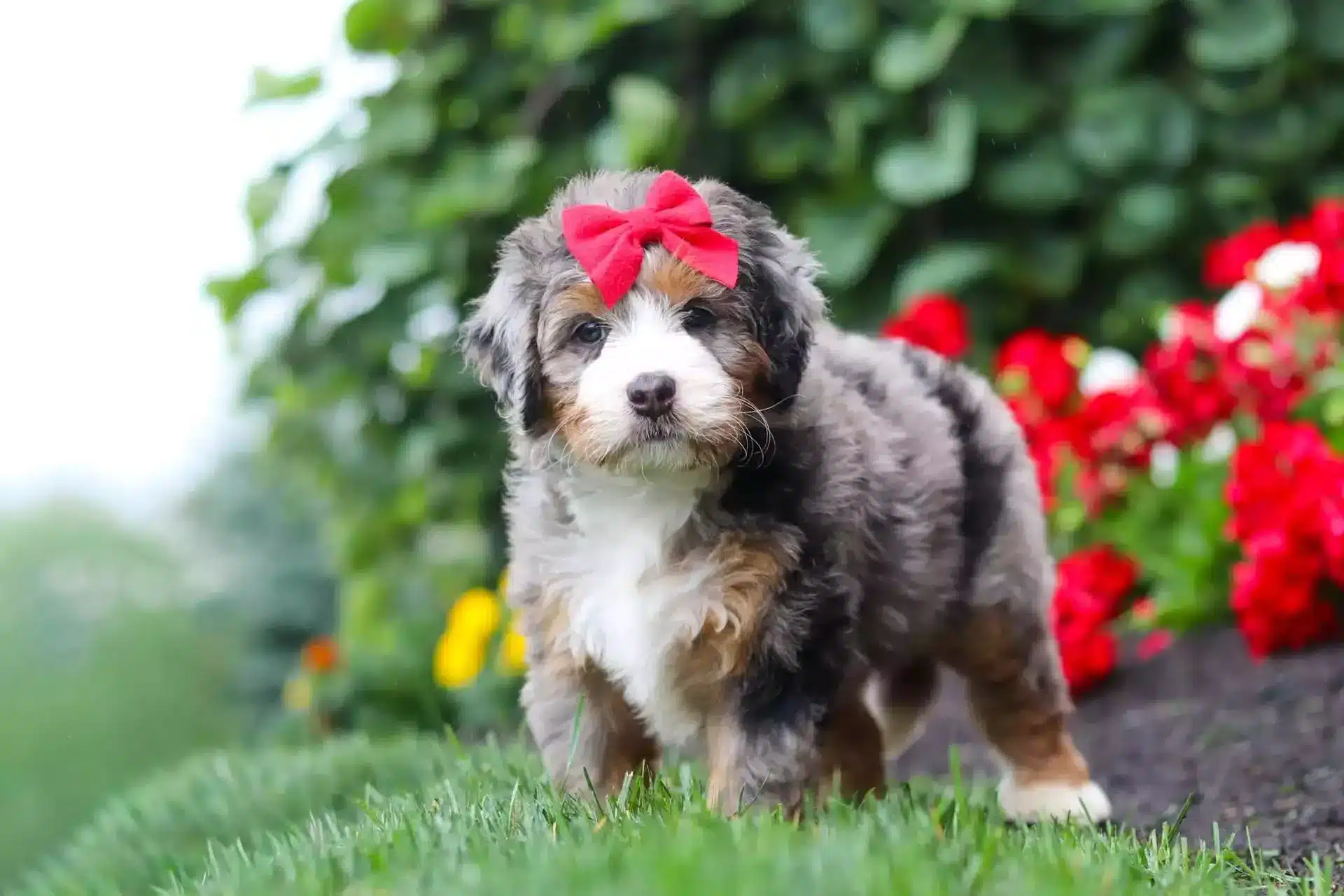
F1B Bernedoodle Guide: What F1B Means, Shedding, Coat, and Temperament
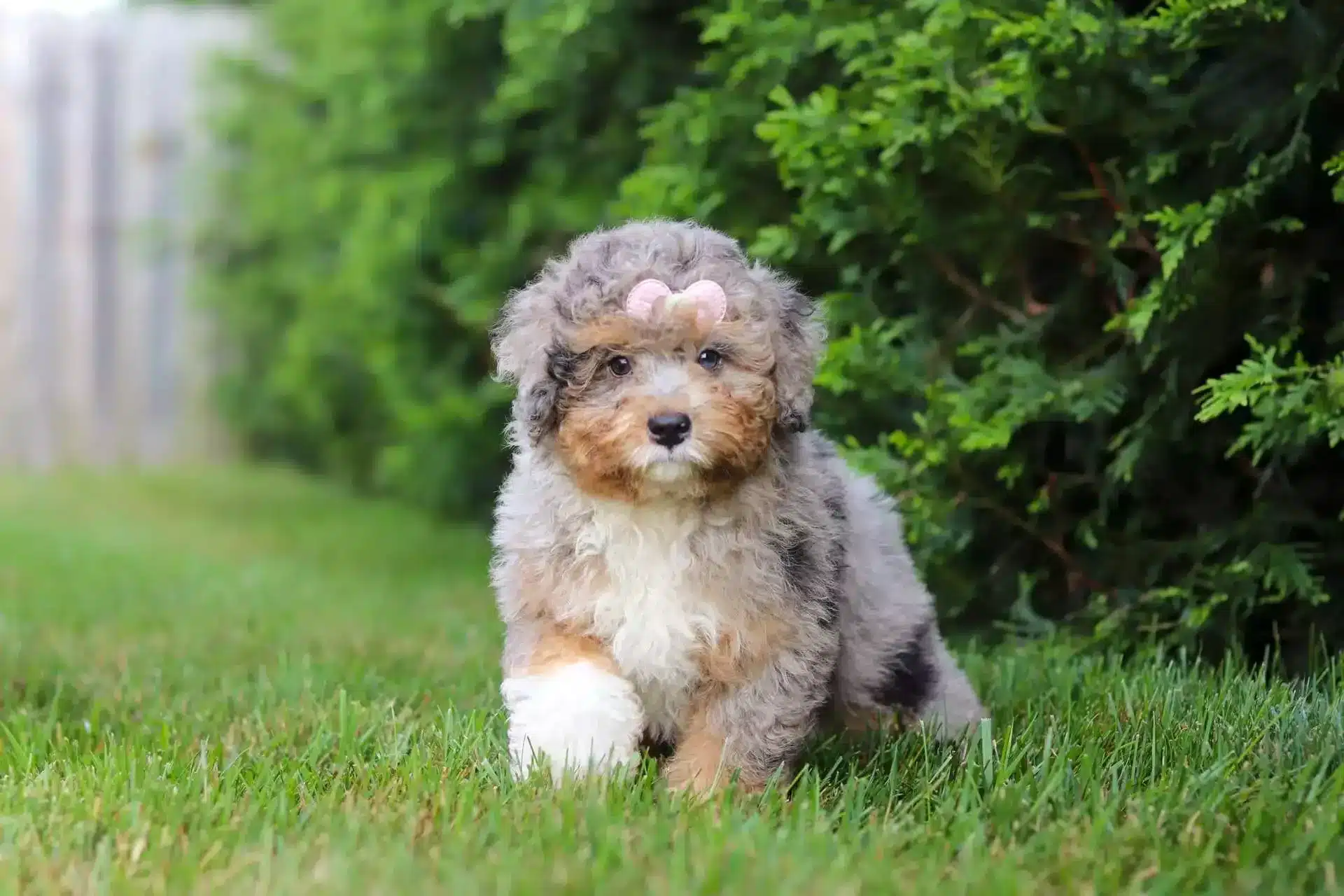
So if you are considering an F1B, use the generation label as a helpful starting point. Then look at the actual parents, puppy, coat, expected size, family lines, and temperament before deciding which dog fits your home.
F1B Bernedoodle: The Short Answer
An F1B Bernedoodle is a first-generation Bernedoodle backcrossed to a parent breed, usually a Poodle. A Poodle-backcross F1B often has a greater chance of Poodle-influenced coat traits and lower visible shedding, but F1B does not guarantee curl, zero shedding, allergy compatibility, temperament, health, or adult size.
F1B Bernedoodle at a Glance
| Trait | What F1B may suggest | What still varies |
|---|---|---|
| Parentage | An F1 Bernedoodle backcrossed to a parent breed, commonly a Poodle | Which individual traits the puppy inherits |
| Coat | Often more Poodle-influenced in a Poodle backcross | Straight, wavy, or curly texture |
| Shedding | Often a better chance of lower visible shedding | The puppy’s actual shedding level |
| Allergy considerations | Lower-shedding coats may appeal to some allergy-sensitive families | Whether an individual person reacts |
| Size | F1B can occur across Bernedoodle size ranges | Final adult weight |
| Temperament | Bernedoodle personality tendencies may still be present | Confidence, sociability, sensitivity, and energy |
| Grooming | Wavier and curlier coats often need substantial care | The exact grooming routine |
| Health | Backcrossing changes ancestry | Individual health outcomes |
The important takeaway is simple: generation gives you context, while the individual puppy gives you the information you will actually live with.
What Does F1B Bernedoodle Mean?
F1B means a first-generation Bernedoodle has been backcrossed to one of the breeds in its ancestry.
Once you break the letters apart, the terminology becomes much easier:
- F means filial, referring to offspring.
- 1 means first generation.
- B means backcross.
An F1 Bernedoodle has a Bernese Mountain Dog parent and a Poodle parent. An F1B begins with that F1 Bernedoodle and pairs it back to one of the parent breeds.
The most common example is:
F1 Bernedoodle + Poodle = F1B Bernedoodle
That pairing averages about 75% Poodle and 25% Bernese Mountain Dog ancestry by pedigree.
The B means backcross. It does not literally mean Poodle. A backcross can technically be made to either ancestral parent breed, although the Poodle backcross is the version families most often encounter when discussing F1B Doodles.
Crockett Doodles currently works with F1, F1B, and Multigen Bernedoodles. If you want to see how all of those labels fit together, read our Bernedoodle Generations Guide.
F1 vs. F1B Bernedoodle: What Is the Difference?
The main difference between an F1 and F1B Bernedoodle is the parent pairing. An F1 has one Bernese Mountain Dog parent and one Poodle parent, while an F1B is an F1 bred back to a parent breed, commonly a Poodle.
| Feature | F1 Bernedoodle | F1B Bernedoodle |
|---|---|---|
| Typical pairing | Bernese Mountain Dog + Poodle | F1 Bernedoodle + Poodle |
| Expected pedigree | About 50% Bernese and 50% Poodle | About 25% Bernese and 75% Poodle in a Poodle backcross |
| Coat tendencies | Can vary from straighter to curlier | Often more Poodle-influenced, but still variable |
| Visible shedding | Variable | Often lower in a Poodle backcross |
| Grooming | Depends on the individual coat | Wavier and curlier coats can require more maintenance |
| Temperament | Individual variation | Individual variation |
| Adult size | Depends mainly on parents and family lines | Depends mainly on parents and family lines |
If you are choosing between F1 and F1B, coat preference is often one of the most practical reasons to compare generations. Temperament, health, trainability, and adult size deserve their own evaluation rather than being predicted from the generation label.
Do F1B Bernedoodles Shed?
Yes, F1B Bernedoodles can shed, although a Poodle-backcross F1B often has a greater chance of lower visible shedding than some F1 Bernedoodles.
Why say “visible shedding”? A curly dog can still lose hair, but some loose hair remains caught inside the surrounding coat instead of immediately landing on your clothes, floors, and furniture. That hair is then removed through brushing and grooming.
Shedding also involves more than one genetic factor. The UC Davis Veterinary Genetics Laboratory identifies variants involving MC5R and RSPO2 as important contributors to relative shedding in dogs.
This is why two F1B puppies can shed differently even when their pedigree percentages look the same.
If lower visible shedding is especially important to you, ask about:
- The puppy’s current coat texture
- Whether the puppy is furnished
- The parent dogs’ coats
- Coat traits seen in related puppies
- Available coat-genetic information
Our Bernedoodle Coat Types Guide explains straight, wavy, and curly coats in more detail.
What Does an F1B Bernedoodle Coat Look Like?
An F1B Bernedoodle from a Poodle backcross may be more likely to develop wavy or curly Poodle-influenced coat traits, but individual puppies can still look quite different.
Some F1B puppies develop loose, shaggy waves. Others become noticeably curlier as the adult coat grows in.
If you love the classic fluffy Doodle appearance, you may naturally be drawn to a furnished, wavy or curly puppy. Just remember that the look and the maintenance usually travel together.
A denser, curlier coat can mean less hair released around the home, but it also gives loose hair more opportunity to become trapped inside the coat.
Does an F1B Bernedoodle Need a Lot of Grooming?
A wavy or curly F1B Bernedoodle can require substantial coat care, particularly if you prefer a longer, fluffy haircut.
This is one of the most useful trade-offs to understand before choosing your puppy. Lower visible shedding does not necessarily mean less grooming.
Tangles can form behind the ears, under collars and harnesses, around the legs, and near the armpits. Coat density, length, activity level, and haircut all influence how quickly mats develop.
If you enjoy the longer teddy-bear look, expect brushing and combing to become part of your normal routine. Professional grooming will also be part of long-term coat care for many F1B Bernedoodles.
For brushing, coat maintenance, and professional grooming guidance, see our Bernedoodle Grooming Guide.
Are F1B Bernedoodles Hypoallergenic?
No dog is completely hypoallergenic, including an F1B Bernedoodle. A curlier, lower-shedding F1B may be worth considering for some families with mild allergy concerns, but coat and generation cannot guarantee that someone will not react.
Dog allergies involve proteins associated with sources such as dander, saliva, urine, and skin material. They are not simply reactions to the loose hair you can see.
The American Academy of Allergy, Asthma & Immunology explains that there are no truly hypoallergenic dog breeds.
Crockett Doodles may suggest considering a very curly F1B or another lower-shedding puppy when a family has mild allergy concerns. That can help narrow the coat conversation, but individual sensitivity still matters.
If someone in your household has moderate or severe dog allergies or asthma, speak with an allergist or physician before choosing a puppy.
Because Crockett Doodles puppies and parent dogs live in private Partner Homes, pre-Adoption Day visits specifically for testing an allergic response are generally unavailable. Our Doodles and Allergies Guide explains this topic in more detail.
What Is an F1B Bernedoodle’s Temperament Like?
An F1B Bernedoodle may be affectionate, social, loyal, gentle, and moderately active, but the F1B generation does not create one predictable personality.
This is where it helps to stop thinking in percentages. A puppy that is 75% Poodle by pedigree does not have a personality that is exactly 75% Poodle.
Temperament develops through a combination of:
- Parent temperament
- Genetics
- Early development
- Socialization
- Training
- Health
- Age
- Household environment
- Individual personality
One F1B puppy may race toward every visitor. A littermate may prefer to observe before joining in. Both can be normal personalities.
If personality and family fit are your biggest questions, our Bernedoodle Temperament Guide covers affection, energy, barking, sensitivity, children, and everyday life in more depth.
Are F1B Bernedoodles Easy to Train?
Many Bernedoodles can be receptive learners, but F1B ancestry does not automatically make a puppy easier to train.
Training depends on the individual dog’s motivation, confidence, age, previous experiences, health, environment, and the way skills are taught.
A puppy may learn “sit” almost immediately in your kitchen and seem to forget it outside when squirrels, smells, and people enter the picture. That is a normal training challenge, not proof that the dog lacks intelligence.
Clear, reward-based training and consistent household expectations can help build cooperation. For a deeper look at focus, stubbornness, leash manners, and positive reinforcement, see our Bernedoodle Behavior and Training Guide.
Are F1B Bernedoodles Good Family Dogs?
An F1B Bernedoodle can be a wonderful family companion when the individual dog’s temperament, adult size, activity needs, grooming requirements, and training needs fit the household.
Rather than asking whether every F1B is a family dog, picture how the individual puppy’s needs would fit your real week.
Think about:
- How much companionship you can provide
- The adult size you can comfortably manage
- How much grooming fits your schedule and budget
- Your activity and training routine
- Children or other animals in the home
- How much time the dog may spend alone
- Long-term veterinary and grooming costs
If time alone is one of your biggest concerns, our Bernedoodle Separation Anxiety Guide explains the difference between normal attachment and separation-related distress.
How Big Does an F1B Bernedoodle Get?
F1B describes generation, not adult size. An F1B Bernedoodle can fall into several adult-size ranges depending mainly on the parent dogs, family lines, and individual growth.
Crockett Doodles uses four estimated Bernedoodle adult-weight categories:
| Crockett Doodles size | Estimated adult weight |
|---|---|
| Toy/Petite | 5 to 24 lb |
| Traditional Mini | 25 to 40 lb |
| Medium | 41 to 55 lb |
| Standard | More than 55 lb |
An F1B is not automatically smaller than an F1. Having more Poodle ancestry also does not give you one predictable adult weight.
If size matters to your household, parent weights, family history, litter estimates, and the individual puppy’s growth pattern provide better clues. Our Bernedoodle Size Guide explains how those estimates work.
How Big Is an F1B Mini Bernedoodle?
At Crockett Doodles, a Traditional Mini Bernedoodle has an estimated adult weight of 25 to 40 pounds. Toy/Petite is a separate 5 to 24-pound category.
If you already have a growing Mini at home, the Bernedoodle Growth Stages Guide explains when smaller Bernedoodles tend to approach physical maturity and how to follow a puppy’s growth trend.
What Is an F1B Micro Bernedoodle?
“Micro” and “Micro Mini” are not universally standardized dog-size categories, so the label can mean different things in different breeding programs.
For practical planning, ask for the puppy’s expected adult-weight range and the adult sizes of both parents. Those numbers tell you much more about the dog you may eventually be lifting, walking, grooming, and traveling with.
Is an F1B Bernedoodle Healthier Than an F1?
An F1B Bernedoodle is not automatically healthier than an F1 Bernedoodle. Generation describes parentage, not a guaranteed health outcome.
Crossbreeding changes genetic ancestry, but Bernedoodles can still inherit health risks associated with either side of their family tree. Parent health information and responsible pairing matter more than simply choosing F1 or F1B.
Crockett Doodles states that its parent dogs undergo genetic health testing through laboratories that may include Embark, Animal Genetics, Royal Canin, Paw Print Genetics, and others. Genetic testing can identify variants included in a particular panel, but it is one part of health evaluation rather than a complete prediction of lifelong health.
Crockett Doodles currently provides a standard one-year Health Guarantee, with extended benefits available when families meet the current food, insurance, veterinary, documentation, and contract requirements. Review the full Crockett Doodles Health Guarantee for the controlling terms.
For broader long-term care and life-expectancy considerations, you can also read our Bernedoodle Lifespan Guide.
Who May Be a Good Fit for an F1B Bernedoodle?
An F1B Bernedoodle may be worth considering if you love the Bernedoodle and place particular value on a greater chance of Poodle-influenced coat traits.
You may enjoy living with an F1B if your family:
- Prioritizes lower visible shedding
- Is comfortable with regular brushing and professional grooming
- Wants an affectionate companion involved in family life
- Can provide training, activity, and socialization
- Has some flexibility about exact adult size and personality
- Understands that allergy response varies by person and dog
The most important part is not choosing the generation with the most appealing label. It is choosing a dog whose daily needs fit the life you can realistically provide.
What Should You Ask Before Choosing an F1B Bernedoodle?
The best F1B Bernedoodle decision combines the generation label with information about the actual puppy, parents, family lines, coat, temperament, and expected adult size.
Before choosing, ask:
- What is the exact parent pairing?
- What are both parents’ adult sizes?
- What coat types do the parents have?
- How is this puppy’s current coat described?
- Is the puppy furnished?
- What shedding or coat tendencies have appeared in related dogs?
- What temperament differences have been observed within the litter?
- What health information is available for both parents?
- What adult-size range is expected?
- What grooming and owner support should we prepare for?
Those answers turn “F1B” from a label into information you can actually use.
Choosing an F1B Bernedoodle With Crockett Doodles
Crockett Doodles coordinates puppies through its network of Partner Homes rather than raising every puppy at one central kennel. Parent dogs generally live as family pets, and the exact circumstances can vary by litter.
If F1B sounds like the right direction, a useful order for choosing is:
family fit → temperament → expected adult size → coat and shedding → grooming commitment → appearance
That keeps a favorite color or curly puppy coat from becoming more important than the qualities you will live with every day.
Current Bernedoodle availability changes by litter, including generation, size, coat, color, and sex. When you are ready, review available Bernedoodle puppies and ask the Crockett Doodles team about the parentage, expected size, coat information, and observed characteristics of puppies you are considering.
Frequently Asked Questions About F1B Bernedoodles
What Percentage Poodle Is an F1B Bernedoodle?
In the common pairing of an F1 Bernedoodle back to a Poodle, the pedigree average is about 75% Poodle and 25% Bernese Mountain Dog. Those percentages describe ancestry rather than an exact split of coat, personality, size, or other individual traits.
Do F1B Bernedoodles Shed?
Yes. Many Poodle-backcross F1B Bernedoodles may release less visible hair than some F1 dogs, but shedding still varies with individual coat genetics.
Are F1B Bernedoodles Hypoallergenic?
No dog is completely hypoallergenic. A curlier, lower-shedding F1B may be worth considering for mild allergy concerns, but it cannot guarantee that an allergy-sensitive person will not react.
Are F1B Bernedoodles Curlier Than F1 Bernedoodles?
They can be. A Poodle-backcross F1B often has a greater chance of Poodle-influenced coat traits, but individual puppies can still develop different coat textures.
Is an F1B Bernedoodle Better Than an F1?
Neither generation is universally better. An F1B may appeal more to families prioritizing Poodle-influenced coats and lower visible shedding, while the better puppy for your household depends on temperament, adult size, coat care, and family fit.
Is an F1B Bernedoodle Easier to Train?
Not automatically. Trainability varies with temperament, motivation, age, experience, health, environment, and training. The F1B label alone cannot predict how easily an individual dog will learn.
How Big Is an F1B Mini Bernedoodle?
At Crockett Doodles, a Traditional Mini Bernedoodle has an estimated adult weight of 25 to 40 pounds. F1B describes the generation rather than the size.
Can Two F1B Bernedoodles Look Different?
Yes. Two F1B puppies can differ in curl, furnishings, color, shedding, adult size, and other traits. Even littermates inherit different combinations of genes from the same parents.
Is an F1B Bernedoodle Right for You?
An F1B Bernedoodle may be a good direction for families who want a greater chance of Poodle-influenced coat traits and are comfortable with the grooming that often comes with a wavy or curly coat.
The F1B label is most helpful when it gives you realistic context about parentage and possible coat tendencies. Your everyday experience will depend much more on the individual puppy’s temperament, size, coat, health, development, and the care your family provides.
When a puppy catches your attention, look beyond the letters. Ask about the parents, expected adult size, coat, family lines, observed temperament, health information, and grooming needs.
That gives you a much stronger foundation for choosing a Bernedoodle that fits your real life.
Ready to Explore F1B Bernedoodles?
Browse available Bernedoodle puppies and ask the Crockett Doodles team about current F1B puppies, parentage, expected adult size, coat characteristics, and family fit.
Bernedoodle F1b Generation, F1b Bernedoodle