Goldendoodle Sizes and Weights: Full Guide by Age

Full-grown Goldendoodles may weigh from about 5 pounds to more than 55 pounds, depending on their expected size range, parents, family lines, health, and growth. Crockett Doodles classifies Goldendoodles as Toy/Petite, Traditional Mini, Medium, or Standard.
These ranges help families plan for crates, beds, travel, lifting, feeding, and space. They are estimates, not guarantees. Littermates can mature at different weights and develop different heights, frames, and body shapes.
This guide explains the official Goldendoodle size ranges, typical growth timing, factors that influence adult weight, and the most useful ways to estimate how big a puppy may become.
For practical planning, prepare for the top of the expected range instead of buying equipment for one exact number or the smallest possible outcome. Families beginning their search can also review current Goldendoodle puppies and breed information.
Goldendoodle Sizes at a Glance
Crockett Doodles uses four non-overlapping adult-weight ranges for Goldendoodles.
| Goldendoodle Size | Estimated Adult Weight | Planning Notes |
|---|---|---|
| Toy/Petite | 5 to 24 pounds | Often easier for adults to lift and usually requires smaller equipment |
| Traditional Mini | 25 to 40 pounds | Compact but substantial and may be easier to transport than a larger dog |
| Medium | 41 to 55 pounds | Requires sturdy equipment, secure transportation, and confident handling |
| Standard | More than 55 pounds | May require larger beds, crates, vehicles, and more handling strength |
These are Crockett Doodles’ expected adult-size ranges based in part on information from previous puppies and family lines. Adult weight may vary with parent size, inherited traits, gender, nutrition, health, and body condition. The ranges are not promised outcomes.
Crockett Doodles uses Toy/Petite as the official name for the smallest category and Traditional Mini for dogs expected to weigh 25 to 40 pounds. Terms such as “Micro,” “Petite Mini,” or “Mini” may appear in individual puppy descriptions, but they do not create additional official size categories.
Crockett Doodles’ official categories are based on expected adult weight rather than one sitewide height chart. Families comparing breeds and sizes can use the Crockett Doodles breed comparison guide.
How Big Do Goldendoodles Get?
Goldendoodles may mature anywhere from the 5-to-24-pound Toy/Petite range to the open-ended Standard category of more than 55 pounds. Some Standard Goldendoodles may become considerably heavier than 55 pounds, so families should ask for a narrower expected range for the puppy or litter.
Adult size is influenced by the full parent pairing, not only the Poodle parent. A Golden Retriever, Poodle, or Goldendoodle parent may contribute genes that affect height, frame, bone structure, body shape, and weight.
A useful adult-size estimate may consider:
- The adult weights and builds of both parents
- The sizes of grandparents and other close relatives
- Adult weights from related puppies and previous litters
- Results from earlier litters produced by similar pairings
- The puppy’s current age, weight, frame, and growth pattern
- Variation previously seen within the family line
A taller or heavier parent may increase the likelihood of larger puppies, but inherited traits do not combine as a simple average. A 20-pound parent and a 60-pound parent do not guarantee a 40-pound adult puppy.
What Determines a Goldendoodle’s Adult Weight?
Both Parents and the Wider Family Line
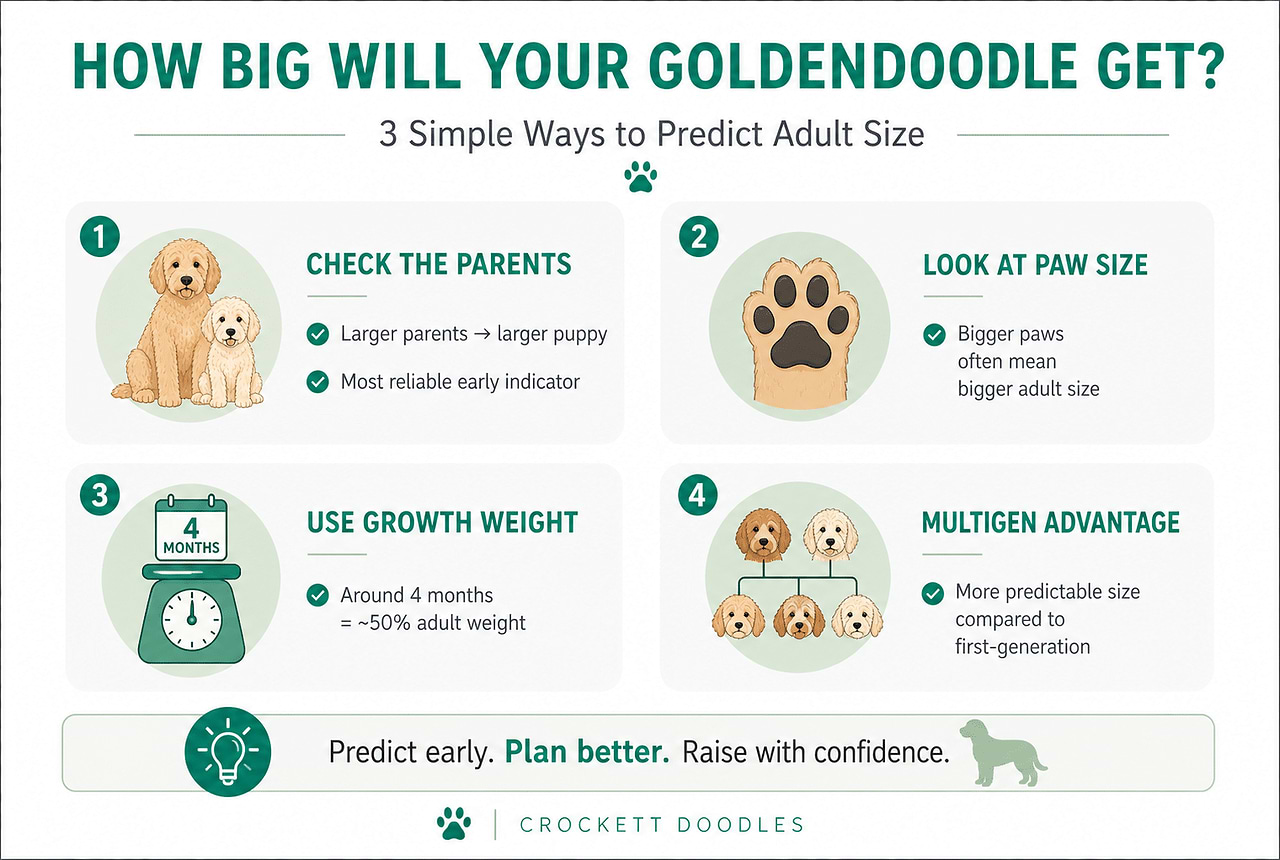
The adult sizes of both parents and related dogs provide the best starting point for estimating a Goldendoodle puppy’s weight. Looking only at the Poodle parent leaves out half of an F1 puppy’s direct ancestry.
For F1B and Multigen puppies, the sizes of the Goldendoodle parents and their wider family lines also matter. Records from similar previous pairings can improve an estimate, but each puppy may inherit a different combination of traits.
Goldendoodle Generation
Generation describes how the parent dogs were paired, not a fixed adult size. An F1, F1B, or Multigen Goldendoodle may fall into any Crockett size category offered for that pairing.
Known Multigen parent sizes may help a breeder estimate a range, but the Multigen label alone does not make adult size certain. An F1B Goldendoodle is not automatically smaller than an F1 Goldendoodle.
“Mini” is also a size description rather than a generation. An F1B Mini Goldendoodle is described by both its breeding generation and its expected adult size. Read the Goldendoodle generation guide for a fuller explanation of F1, F1B, and Multigen pairings.
Gender and Individual Genetics
Males may sometimes mature larger than females from similar family lines, but gender alone cannot predict adult weight. A female may outgrow a male littermate when the puppies inherit different structural traits.
Frame, bone structure, health, and body composition also affect the number shown on the scale. A weight range cannot fully describe a dog’s height, proportions, or overall build.
Nutrition, Growth, and Body Condition
Food should support steady, healthy growth rather than push a puppy toward a preferred weight. Feeding more cannot safely make a puppy reach a larger genetic size. Excess calories may add body fat and encourage overly rapid growth rather than healthy height or structure.
Veterinarians assess body condition and muscle condition as well as scale weight. A puppy may weigh more because of excess body fat or less because of a lean frame, illness, parasites, nutrition, or normal individual variation.
Body-condition scoring considers features such as the ribs, waist, and abdominal shape instead of relying only on one number. Owners can review the World Small Animal Veterinary Association dog body-condition chart and ask their veterinarian to demonstrate how it applies to their puppy.
Crockett Doodles currently recommends TLC Whole Life or Health Extension. Qualifying purchases made through Crockett Doodles’ designated links support extended Health Guarantee eligibility. Confirm the puppy’s current diet before Adoption Day, avoid an abrupt change, and review the current Crockett Doodles puppy food guidance.
A veterinarian may recommend another diet because of an allergy, digestive condition, growth concern, or other medical need. Follow the veterinarian’s guidance and contact Crockett Doodles to understand how a medically necessary change could affect Health Guarantee eligibility.
Goldendoodle Growth Chart by Age
A useful Goldendoodle growth chart tracks a puppy’s progress over time instead of promising a set weight at each age. Puppies within the same expected adult-size category may follow noticeably different growth curves.
| Puppy’s Age | What Owners May Notice | How to Use the Information |
|---|---|---|
| 8 weeks | Early weight reflects birth size, litter conditions, and early development | Record a starting weight, but do not use it alone to predict adult size |
| 3 to 4 months | Rapid growth may make the puppy look leggy or temporarily out of proportion | Compare several measurements rather than relying on one formula |
| 6 months | Some smaller puppies may be closer to adult height, while larger puppies often have substantial growth ahead | Review the puppy’s trend with the breeder and veterinarian |
| 9 months | Some Toy/Petite and Traditional Mini dogs may be approaching mature weight | Measure for current equipment rather than relying only on the original estimate |
| 12 months | Many smaller dogs are near adult size, while larger Goldendoodles may still be developing | Continue monitoring weight, body condition, and muscle condition |
| 15 to 18 months | Many larger dogs are nearing skeletal maturity | Expect individual differences and avoid encouraging rapid growth with excess calories |
| Into the second year | Some larger dogs may continue developing mature body composition and structure | Do not assume every Standard has its final adult build at one year |
Research-based canine growth charts use separate curves for different expected adult-weight groups because small and large dogs develop at different rates. Repeated measurements provide more useful information than one universal puppy chart or one-time calculation.
General canine growth guidance indicates that many small and medium dogs approach skeletal maturity around one year, while larger dogs may continue growing until approximately 15 to 16 months or longer. Some dogs continue filling out after height growth slows.
These timelines are general patterns rather than deadlines. Skeletal maturity, final scale weight, and mature body composition are related, but they are not identical.
Can You Double a Puppy’s Weight to Predict Adult Size?
Doubling a Goldendoodle puppy’s weight at a certain age may produce a rough guide, but it cannot reliably guarantee adult size.
Online formulas may recommend doubling a puppy’s weight at 14, 16, or 20 weeks. These shortcuts assume puppies within a category grow at similar rates. Goldendoodles vary too widely in parent size, generation, frame, health, and growth timing for one multiplier to work consistently.
An early growth spurt may create an estimate that is too high, while a slowly maturing larger puppy may produce an estimate that is too low. Evidence-based growth standards separate dogs by expected adult size and gender because growth patterns differ.
Use a formula only as an informal planning tool. Parent sizes, family history, repeated measurements, veterinary growth monitoring, and adult results from similar pairings provide a better overall range.
Do Large Paws Mean a Goldendoodle Will Be Big?
Large paws may suggest that a Goldendoodle puppy has more growing to do, but paw size alone cannot reliably predict adult weight.
Puppies often appear temporarily out of proportion because their paws, legs, head, and body may grow at different rates. Coat volume can also make the paws look larger than the structure underneath.
Treat paw size as a casual observation. It should not outweigh parent information, family-line history, repeated weight measurements, or the breeder’s expected adult range.
How to Estimate Your Goldendoodle Puppy’s Adult Size
Use several sources of information instead of relying on one calculator, formula, or visual clue.
- Confirm the official size category. Ask whether the puppy is estimated as Toy/Petite, Traditional Mini, Medium, or Standard.
- Request both parents’ adult weights. Their height, frame, and healthy body condition may provide useful context.
- Ask about related puppies. Adult weights from previous litters, siblings, and close relatives can support the estimate.
- Review the puppy’s current age and weight. A series of measurements is more useful than one number.
- Ask how the range was developed. A responsible estimate should be based on more than paw size or a generic calculator.
- Plan for variation. Choose equipment and housing with room for the puppy to finish away from the center of the expected range.
- Track growth with your veterinarian. Veterinary assessment can distinguish healthy development from excess body fat, inadequate nutrition, illness, or another concern.
If the puppy’s weight changes suddenly, growth stalls, or body condition becomes difficult to assess, consult a veterinarian instead of changing portions based only on an online chart.
Toy/Petite Goldendoodle Size
A Toy/Petite Goldendoodle has an estimated adult weight of 5 to 24 pounds.
This category covers a broad range. A 6-pound adult and a 23-pound adult both qualify as Toy/Petite under Crockett Doodles’ size system, but their lifting, travel, feeding, and equipment needs may differ considerably.
Smaller Goldendoodles may be easier for many adults to lift or carry. Small size does not guarantee calm behavior, low activity, airline eligibility, or suitability for every home.
Families with young children should also consider safe interaction. Very small puppies may be at greater risk from accidental falls, being stepped on, or rough handling.
Traditional Mini Goldendoodle Size
A Traditional Mini Goldendoodle has an estimated adult weight of 25 to 40 pounds.
Traditional Minis may feel substantial while remaining easier to transport or assist than many Standards. Crockett Doodles’ official range begins at 25 pounds and ends at 40 pounds.
A puppy described only as “Mini” should not automatically be assumed to remain under 25 pounds. Ask whether the estimate refers to Toy/Petite or Traditional Mini and confirm the stated adult range.
A Traditional Mini can mature outside the expected category. For example, a puppy estimated near the top of the range may eventually weigh more than 40 pounds and fall within the Medium category.
Medium Goldendoodle Size
A Medium Goldendoodle has an estimated adult weight of 41 to 55 pounds.
Mediums occupy the defined range between Traditional Mini and the open-ended Standard category. They may appeal to families seeking a more substantial dog without choosing a Standard estimate.
A 41-pound Medium and a 55-pound Medium may still differ noticeably in height, frame, lifting difficulty, pulling strength, and equipment needs.
Before choosing this size, consider whether each caregiver can safely control, transport, and assist a dog near the top of the expected range.
Standard Goldendoodle Size
A Standard Goldendoodle is expected to weigh more than 55 pounds as an adult.
Standard has no set upper weight in Crockett Doodles’ size system. Families should request a narrower range for the litter or puppy based on both parents, related dogs, and earlier similar pairings.
Standards generally require larger crates, beds, collars, harnesses, and vehicle space. Owners should also plan for situations when the dog may require physical assistance, such as entering a vehicle, recovering from a procedure, or navigating stairs.
A yard is not automatically required, and a large home does not automatically make a household suitable for a large dog. Daily routine, handling ability, training, safe outdoor activity, and the ability to manage a full-grown dog matter more than square footage alone.
Which Goldendoodle Size Fits Your Home?
The right Goldendoodle size is one your household can safely handle, transport, house, and support throughout the dog’s adult life.
Consider these practical questions:
- Can every caregiver safely control a dog at the top of the expected range?
- Could someone lift or assist the dog during an emergency?
- Does your vehicle provide enough secure space?
- Will a suitable adult crate and bed fit in your home?
- Are there stairs, narrow walkways, rental limits, or weight restrictions?
- Do you frequently move, fly, or stay in pet-restricted accommodations?
- Can children interact safely with a very small or very large puppy?
- Are you prepared if the dog matures outside the expected category?
Apartment living does not automatically require a Toy/Petite or Traditional Mini Goldendoodle. A Standard may do well in a smaller home when its needs are met, while a small dog may still require substantial daily activity and attention.
Size and Daily Activity
Size can affect handling, equipment, and some exercise considerations, but it does not determine energy level by itself. A small Goldendoodle may be highly active, while a larger dog may prefer a more moderate routine.
Age, health, conditioning, personality, weather, and individual energy should shape the exercise plan. Families seeking structured support can review Crockett Doodles’ puppy training options.

Size should be one part of the decision. It cannot predict personality, activity level, trainability, coat-care needs, or family compatibility.
Planning for Goldendoodle Equipment and Travel
Planning for the full expected range can reduce the need to replace equipment as the puppy grows. An adjustable crate divider, appropriately sized harness, secure vehicle restraint, and bed with room for mature body length may be useful.
Crockett Doodles’ puppy shopping list provides ideas for crates, harnesses, grooming tools, toys, and other supplies. Families arranging Adoption Day travel can also review the current delivery and pickup information.
Do not choose air-travel equipment based only on an early puppy estimate. Airlines, routes, carriers, and adult dog dimensions have separate requirements, and not every small Goldendoodle will qualify for in-cabin travel.
Questions to Ask About a Puppy’s Size Estimate
Before reserving a Goldendoodle puppy, ask:
- What is the puppy’s official Crockett size category?
- What are the healthy adult weights and builds of both parents?
- How large did puppies from previous similar pairings become?
- How much variation has occurred within related litters?
- What is the puppy’s current weight and exact age?
- Is the estimate a broad category or a narrower expected range?
- What information was used to develop the estimate?
- Could the puppy mature outside the stated category?
- Does the written Health Guarantee promise adult size?
Crockett Doodles’ current Health Guarantee does not guarantee final adult height or weight. Size ranges help families plan, while the written agreement controls coverage, requirements, exclusions, and claim procedures. Review the current Crockett Doodles Health Guarantee before Adoption Day.
Frequently Asked Questions
What Goldendoodle sizes are available?
Crockett Doodles classifies Goldendoodles into four adult-size categories: Toy/Petite at 5 to 24 pounds, Traditional Mini at 25 to 40 pounds, Medium at 41 to 55 pounds, and Standard at more than 55 pounds.
How much will my Goldendoodle weigh when fully grown?
A Goldendoodle’s final weight is influenced by both parents, family lines, inherited traits, gender, health, nutrition, and body condition. The breeder’s expected size category is useful for planning, but it cannot guarantee one final number.
When do Goldendoodles stop growing?
Many smaller Goldendoodles approach adult size around their first birthday, while Medium and Standard Goldendoodles may continue developing for longer. Some larger dogs may not reach skeletal maturity until approximately 15 to 16 months, and mature body composition may continue developing afterward.
What is a full-grown Mini Goldendoodle’s weight?
Under Crockett Doodles’ system, a Traditional Mini Goldendoodle is estimated to weigh 25 to 40 pounds as an adult. Toy/Petite Goldendoodles are smaller, with an estimated adult range of 5 to 24 pounds.
What is a Standard Goldendoodle’s full-grown weight?
A Standard Goldendoodle is expected to weigh more than 55 pounds. Because the category has no official upper limit, ask for a narrower estimate based on the parents, family line, and comparable past litters.
Are male Goldendoodles always larger than females?
No. Male Goldendoodles are not always larger than females. Gender may influence size within some family lines, but individual genetics can outweigh that tendency. A female may mature larger than a male littermate.
Can a Goldendoodle grow outside its estimated size category?
Yes. A Goldendoodle can mature outside its expected category because size labels are estimates, not guarantees. A puppy estimated as a Traditional Mini may mature as a Medium, while another puppy may remain smaller than expected.
Does generation determine Goldendoodle size?
No. F1, F1B, and Multigen describe parent pairings rather than adult weight. Any of these generations may appear in different size categories when suitable parents are paired.
What does a Goldendoodle growth chart show?
A Goldendoodle growth chart should show how a puppy’s weight and body condition change over time. It can help owners and veterinarians identify trends, but it should not be treated as a promise of one adult weight.
Plan for a Range, Not One Number
Goldendoodle sizes extend from Toy/Petite dogs expected to weigh 5 to 24 pounds to Standards expected to exceed 55 pounds. The most useful adult-size estimate combines both parents, wider family history, similar past litters, the puppy’s current development, and veterinary growth monitoring.
No growth chart, paw measurement, generation label, or formula can promise an exact adult weight. Planning for the full expected range helps families choose suitable equipment, transportation, housing, and handling arrangements before the puppy comes home.
Families comparing Goldendoodle puppies can review the stated size category for each puppy and ask how the estimate was developed. Explore available Goldendoodle puppies for puppy-specific information.
goldendoodle size chart, goldendoodle sizes, goldendoodle weight, mini goldendoodle size, sizes of goldendoodles