Merle Bernedoodle Guide: Genetics, Health, Colors, and Choosing a Puppy

This guide will help you understand the pattern without turning the decision into a genetics lesson. You will learn what blue merle means, why double merle matters, and which questions are useful before reserving a puppy.
Merle Bernedoodle: The Short Answer
A merle Bernedoodle has a genetically determined pigmentation pattern that creates irregular areas of diluted and fully pigmented color. A merle coat by itself does not determine temperament, size, generation, or overall health. The main breeding concern is avoiding pairings that can produce double-merle puppies.
Merle Bernedoodle at a Glance
| Question | Short answer |
|---|---|
| What is merle? | A genetic pigmentation pattern that creates irregular diluted and fully pigmented areas |
| Is merle a Bernedoodle generation? | No. Merle describes coat pattern, not F1, F1B, or Multigen status |
| What is blue merle? | Black-based pigment broken into black and gray or silver-looking areas |
| Is a merle puppy automatically unhealthy? | No. Merle pattern alone is not a diagnosis |
| What is the main breeding concern? | Producing double-merle puppies by combining merle variants from both parents |
| Does merle affect temperament? | Merle pigmentation does not predict personality |
| Does merle determine size? | No. Adult size depends much more on the parents and family lines |
| What should buyers verify? | Parent pairing, merle DNA results when relevant, broader health information, size, coat, and temperament |
What Is a Merle Bernedoodle?
A merle Bernedoodle has a coat pattern in which areas of pigment are diluted while other areas remain fully pigmented.
The UC Davis Veterinary Genetics Laboratory describes merle as an incompletely dominant pattern associated with a SINE insertion in the PMEL gene. The visible result can range from obvious marbling to much subtler patterning depending on the merle allele and the dog’s other color genes.
That means merle tells you something about pigmentation, but surprisingly little about the rest of the dog.
A merle Bernedoodle may be a smaller or larger Bernedoodle, belong to different generations, and have a wavy or curly coat. One merle puppy may be outgoing while another is more observant. Color simply is not a shortcut for size, personality, trainability, or overall health.
If generation labels are also part of your puppy search, our Bernedoodle Generations Guide explains F1, F1B, and Multigen separately.
What Does a Blue Merle Bernedoodle Look Like?
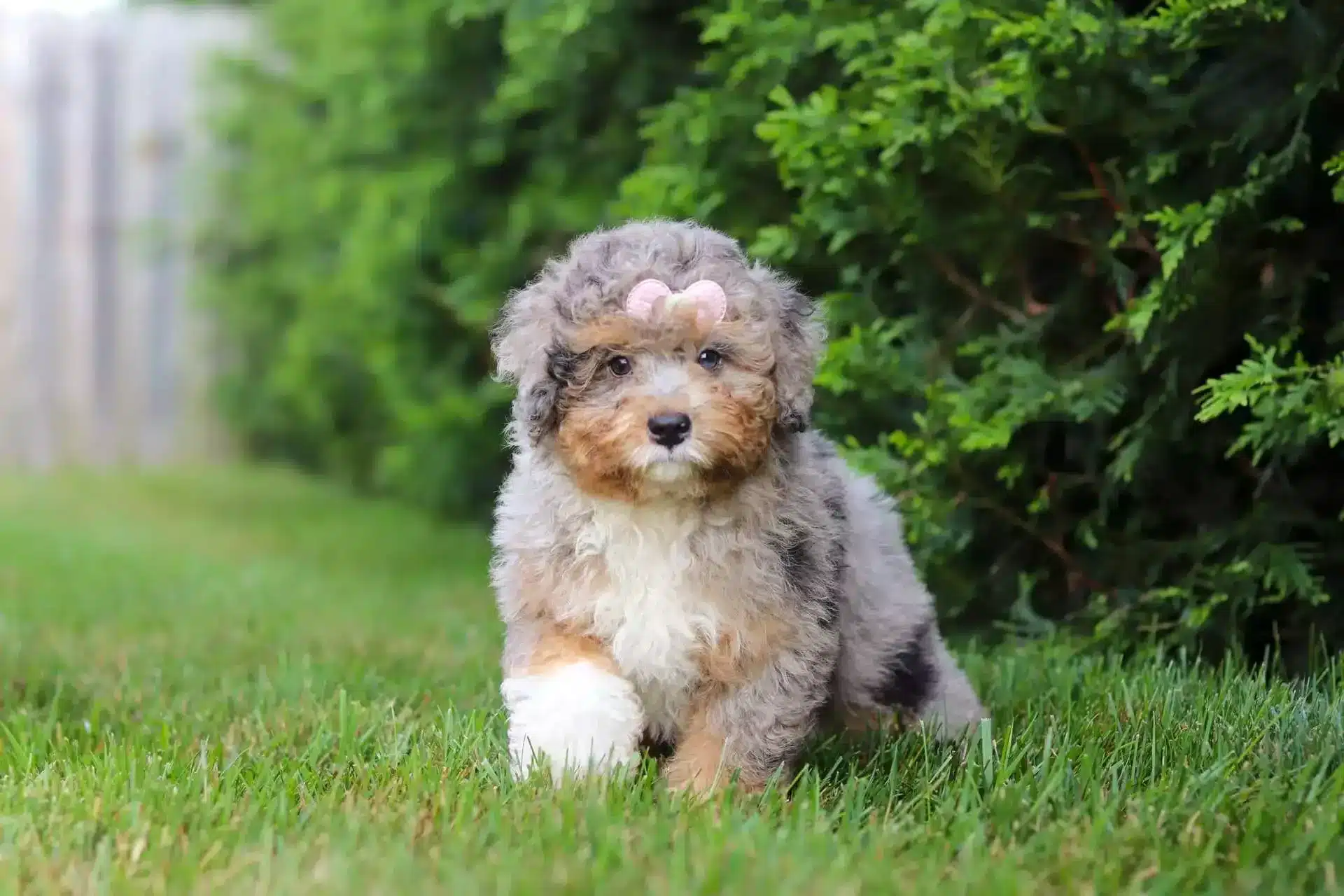
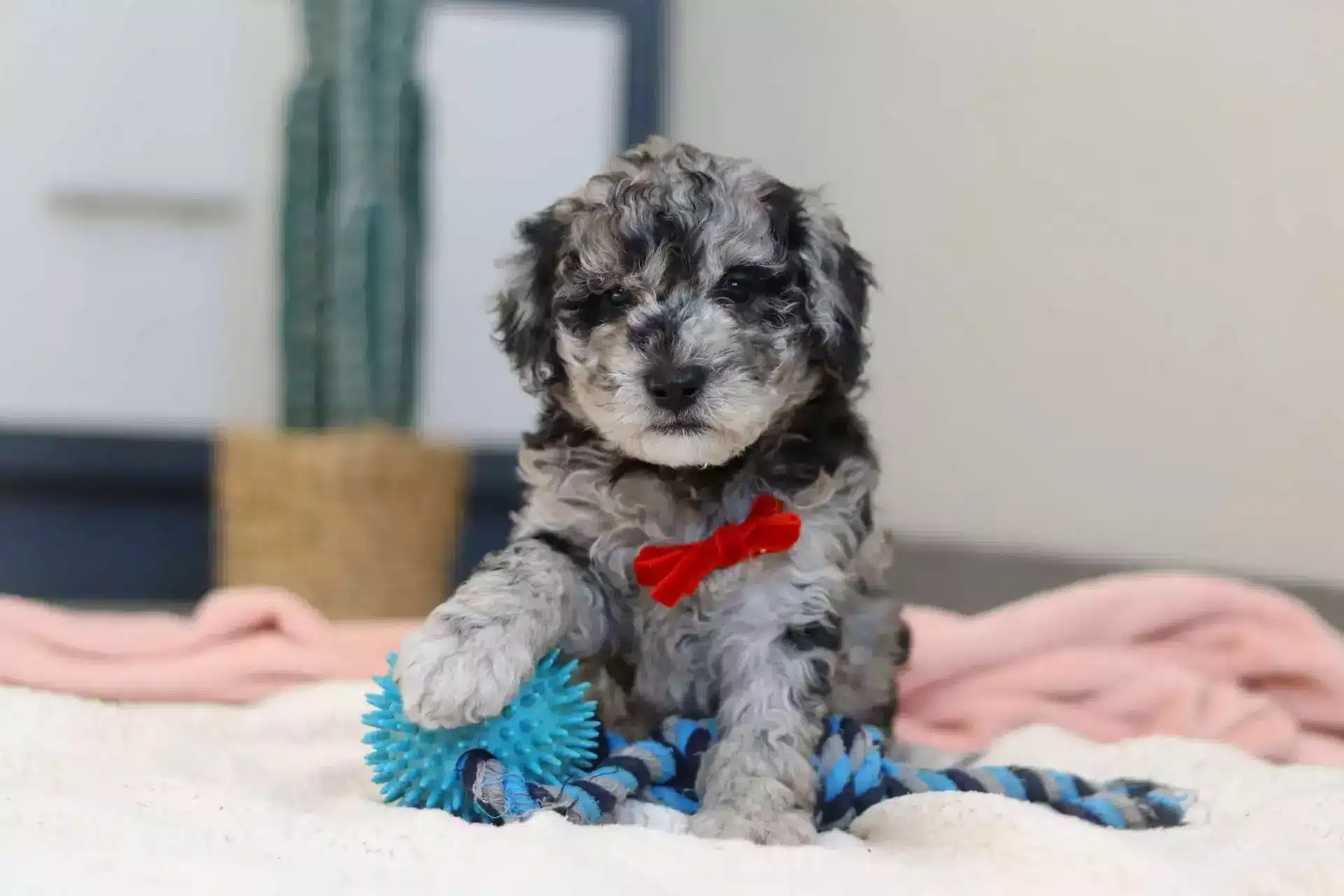
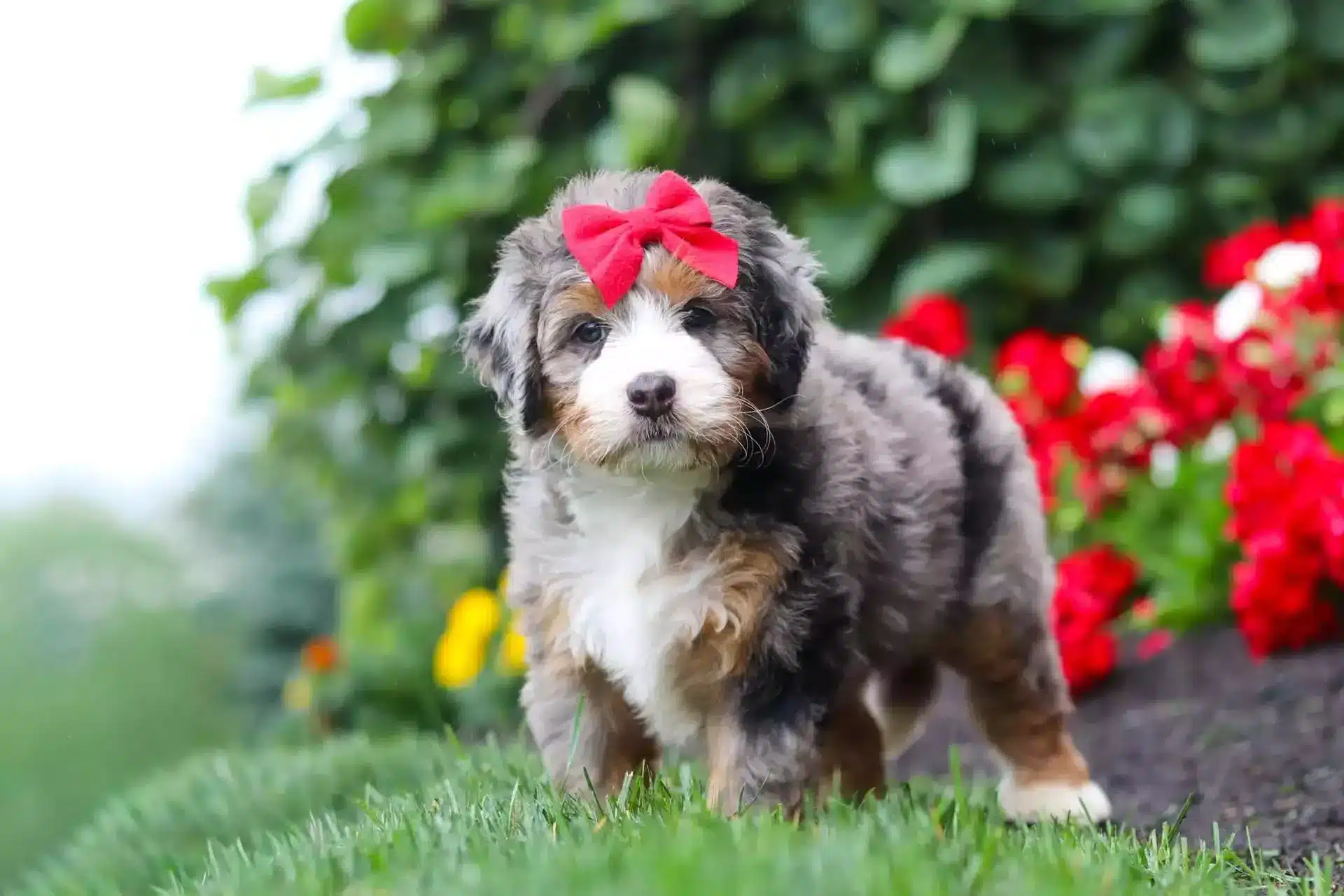
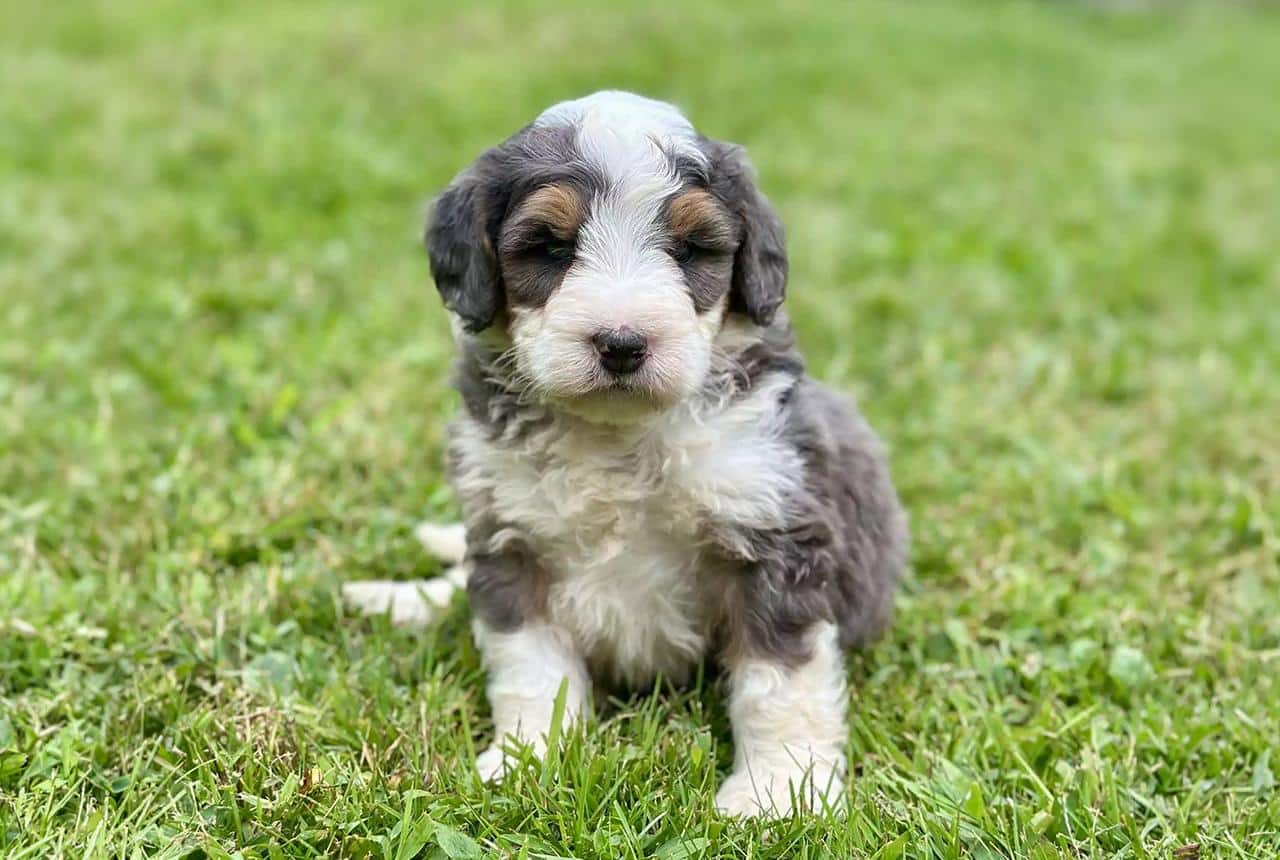
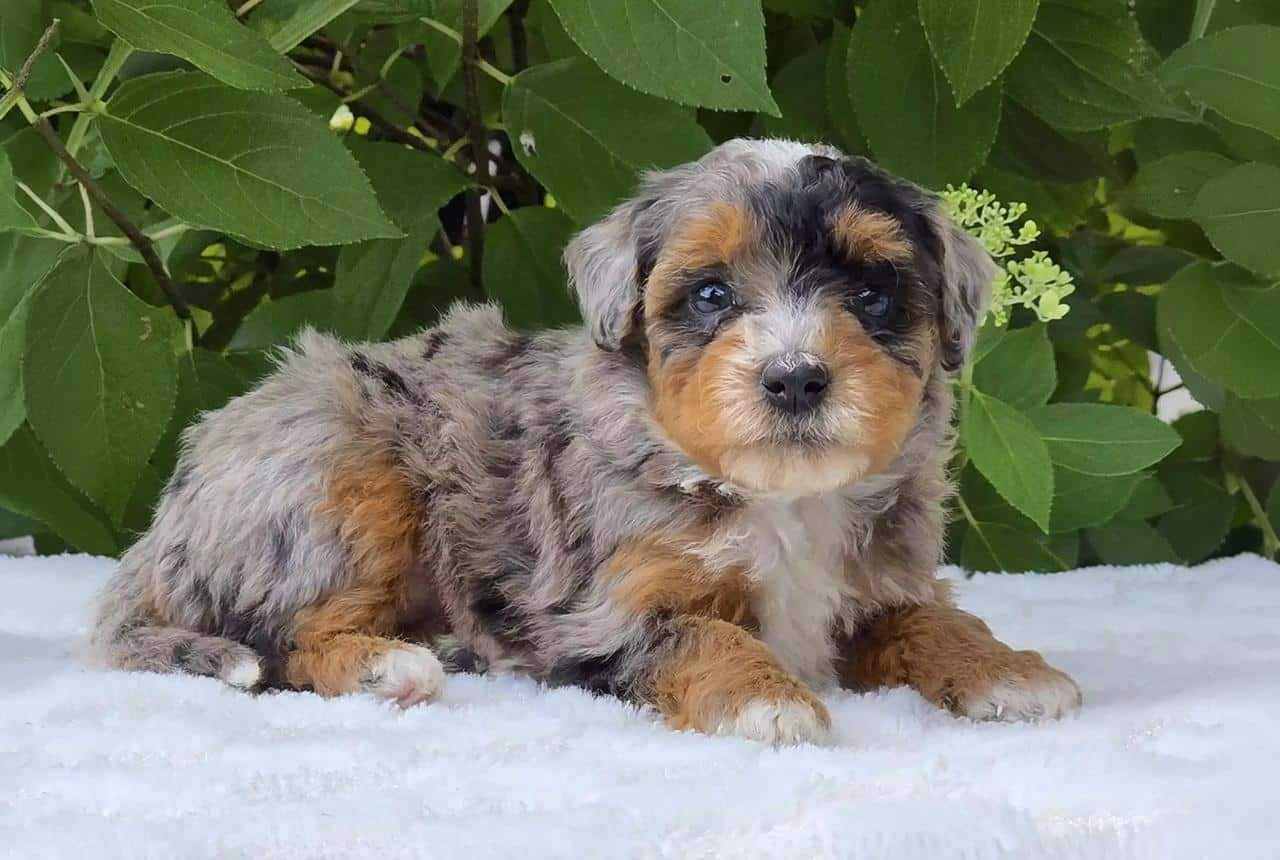
A blue merle Bernedoodle typically has black-based pigment broken into black and diluted gray or silver-looking patches. The word “blue” describes the visual effect rather than literal blue fur.
White markings and tan points can appear alongside merle, which is why you may also see terms such as tri-merle or merle phantom.
Eye color can vary too. A merle dog may have brown eyes, blue eyes, partially blue or marbled eyes, or two eyes of different colors. Merle can influence eye pigmentation, but an unusual eye color does not tell you by itself whether the eye is healthy.
Merle Bernedoodle Genetics in Plain English
Merle genetics sound technical quickly, but the buyer takeaway is straightforward: appearance alone cannot always tell you a dog’s merle genotype.
UC Davis explains that merle is linked to a SINE insertion in PMEL and that the length of part of that insertion can influence how strongly the pattern appears. Some merle-associated variants create obvious marbling. Others may produce very little visible merle.
Merle also affects eumelanin, the pigment responsible for black or brown coloration. In some genetic backgrounds, a dog may carry a merle-associated variant without displaying an obvious merle pattern.
That is why DNA testing is useful when merle is involved in a breeding program. It gives breeders information that a visual coat check may miss and helps them avoid pairings that could produce double-merle puppies.
What Is a Double Merle Bernedoodle?
A double merle Bernedoodle inherits merle-associated variants from both parents. Double-merle dogs have a higher risk of congenital hearing and eye abnormalities, with other developmental abnormalities also reported.
A double merle may have extensive white in the coat, but appearance is not enough to establish genotype. Some dogs with two merle variants can look different from the stereotypical mostly white image people associate with double merle.
Single Merle vs. Double Merle
| Factor | One merle-associated variant | Double merle |
|---|---|---|
| Appearance | May be obvious, subtle, or partly masked | May show extensive dilution or white, but appearance varies |
| Health meaning | Merle pattern alone does not establish disease | Higher concern for congenital auditory and ophthalmologic abnormalities |
| What a buyer should verify | Parent merle status and broader health information | DNA status plus appropriate veterinary evaluation |
| Breeding implication | Pairing decisions should use known genetic status | Passing a merle variant to offspring is expected |
UC Davis notes that double-merle dogs may have auditory, ophthalmologic, skeletal, cardiac, reproductive, and other abnormalities. This is why understanding the genetic status of both parents matters when merle is part of a breeding program.
Should Two Merle Dogs Be Bred Together?
Breeding two dogs with merle-associated variants is discouraged because the pairing can produce double-merle puppies.
For a prospective owner, you do not need to become a canine geneticist. You simply need a breeder who can explain the pairing clearly and show the relevant testing.
A useful question is: “What were the merle DNA results for both parents?”
That question is stronger than asking whether both parents look merle because some merle variants can be subtle or visually masked.
Are Merle Bernedoodles Healthy?
A merle coat by itself is not a diagnosis of poor health. A puppy’s health picture depends on the pairing, broader inherited risks, veterinary care, and the individual dog.
Merle testing answers one specific coat-genetics question. It does not replace the rest of a responsible health evaluation.
When you are considering a merle puppy, ask what genetic testing or other health information is available for both parents, what results matter to the particular pairing, and how the puppy has been cared for before Adoption Day.
Crockett Doodles states that parent dogs undergo genetic testing through laboratories that may include Embark, Animal Genetics, Royal Canin, Paw Print Genetics, and others. Genetic panels can identify the variants included in a particular test, but genetic testing is only one part of evaluating overall health.
Crockett Doodles also provides a standard one-year Health Guarantee, with extended benefits available when the current insurance, food, veterinary, documentation, and contract requirements are met. You can review the full Crockett Doodles Health Guarantee for the controlling terms.
Where Does Merle Come From in a Bernedoodle?
This is a useful question because merle is not part of the Bernese Mountain Dog breed standard.
The Bernese Mountain Dog Club of America breed standard describes the Bernese Mountain Dog as tri-colored with a jet-black ground color, rust markings, and white markings. A ground color other than black is a disqualification.
Crockett Doodles has historically described some merle Mini Bernedoodles as coming from a merle-patterned Mini Poodle parent.
At the same time, the Poodle Club of America breed standard calls for an even, solid-colored coat and does not list merle as a standard Poodle color.
If lineage is especially important to you, ask about the documented pedigree and genetic information for the actual parent dogs rather than making assumptions from color alone.
Merle, Phantom, Parti, and Tri-Color Are Different
These terms describe different parts of a dog’s appearance, and more than one can apply to the same puppy.
| Term | What it describes |
|---|---|
| Merle | Irregular areas of diluted and fully pigmented color |
| Phantom | Tan-point markings in characteristic locations |
| Parti | Significant white areas paired with another color or pattern |
| Tri-color | Three visible colors or marking components |
| Tri-merle | Merle combined with white and tan-point style markings |
That is why one Bernedoodle can reasonably be described with more than one color or pattern term.
If appearance is a big part of your puppy search, the Bernedoodle Colors Guide gives you a broader look at common colors and markings.
Does Merle Affect Bernedoodle Temperament?
Merle affects pigmentation, not personality, so coat pattern should not be used to predict a Bernedoodle’s temperament.
A puppy’s behavior is better understood by looking at parent temperament, individual observations, early development, socialization, health, training, age, and environment.
Crockett Doodles generally describes Bernedoodles as loyal, calm, social, gentle, and moderately active. Those are broad tendencies rather than promises for every puppy.
If personality is more important to you than pattern, our Bernedoodle Temperament Guide gives you a better framework for comparing affection, energy, trainability, barking, and family fit.
Does a Merle Bernedoodle Need Different Grooming?
Merle changes coat pigmentation, not the basic grooming requirements of the coat.
A curly merle Bernedoodle and a curly non-merle Bernedoodle will generally have similar coat-care responsibilities. What matters more is curl, density, length, furnishings, activity, and haircut style.
Curlier coats may release less visible hair, but they can also hold loose hair inside the coat and develop mats without regular brushing and combing.
Our Bernedoodle Coat Types Guide explains straight, wavy, and curly coats and the grooming trade-offs that come with each.
For detailed brushing and professional grooming guidance, you can also read the Bernedoodle Grooming Guide.
Does Merle Determine Bernedoodle Size?
No. Merle is a pigmentation pattern and does not create a separate Bernedoodle size.
Crockett Doodles uses four estimated adult-weight categories:
| Size | Estimated adult weight |
|---|---|
| Toy/Petite | 5 to 24 pounds |
| Traditional Mini | 25 to 40 pounds |
| Medium | 41 to 55 pounds |
| Standard | More than 55 pounds |
A merle Bernedoodle may fall into any available size range depending on the parent dogs and family lines.
If you see a puppy described as a Mini Merle Bernedoodle, focus on the expected adult-weight range and both parents’ sizes. Our Bernedoodle Size Guide explains how to use those clues without expecting an exact final weight.
If you already have a growing puppy at home, the Bernedoodle Growth Stages Guide can help you understand how size changes through puppyhood.
How to Choose a Merle Bernedoodle Puppy
Choose a merle Bernedoodle by putting health information, parentage, temperament, family fit, and long-term care ahead of the pattern itself.
Before reserving a puppy, ask:
- What is the exact parent pairing?
Find out which parent carries the merle pattern. - What are both parents’ merle DNA results?
This matters because appearance may not reveal every merle-associated variant. - What broader parent health information is available?
A merle test answers only one genetic question. - What adult size is expected?
Color does not predict weight. - What coat texture does the puppy have?
Texture will affect grooming more than the merle pattern. - What temperament differences have been observed?
Look for the individual puppy that fits your household. - How are the puppies being raised?
Ask about the home environment, handling, veterinary care, and early experiences. - What support and guarantee come with the puppy?
Review the current written terms and available post-adoption support.
If you are a first-time owner, our Bernedoodle Behavior Guide can also help you understand training, focus, socialization, and everyday puppy behavior before Adoption Day.
Choosing a Merle Bernedoodle With Crockett Doodles
Crockett Doodles raises and places puppies through a network of Partner Homes rather than one central kennel. Parent dogs generally live as family pets, and the circumstances of each litter can vary.
Merle Bernedoodles may appear in current Crockett Doodles puppy listings, but availability changes by litter. A particular merle pattern, size, sex, generation, or coat should be confirmed rather than assumed.
If merle catches your eye, keep it as one preference among several. Ask the Crockett Doodles team about:
- The specific puppy’s parent pairing
- Available merle and genetic information
- Expected adult size
- Coat type and grooming expectations
- Observed temperament
- Current Health Guarantee
- Other puppies that may also fit your family
Color can help you narrow the puppies you love looking at. Temperament, size, health information, coat care, and family fit help you decide which puppy you will enjoy living with.
Frequently Asked Questions About Merle Bernedoodles
What Is a Blue Merle Bernedoodle?
A blue merle Bernedoodle has black-based pigment affected by merle, creating irregular black and gray or silver-looking areas. White or tan markings may appear too.
Is a Merle Bernedoodle a Different Breed?
No. Merle describes a coat-pigmentation pattern. A merle Bernedoodle is still a Bernedoodle.
Are Merle Bernedoodles Unhealthy?
Not simply because they are merle. The greater genetic concern involves double merle, which occurs when merle-associated variants are inherited from both parents. Broader health still depends on the individual dog and the pairing.
What Is a Double Merle Bernedoodle?
A double merle inherits merle-associated variants from both parents. Double-merle dogs have an increased risk of congenital hearing and eye abnormalities, with other developmental abnormalities also reported.
Can Two Merle Dogs Produce Double-Merle Puppies?
Yes. When merle-associated variants are inherited from both parents, a puppy can be double merle. Genetic testing helps breeders understand parent status, including variants that may not be obvious from appearance.
Do All Merle Bernedoodles Have Blue Eyes?
No. Merle Bernedoodles may have brown, blue, partially blue, marbled, or differently colored eyes. Coat pattern does not guarantee eye color.
Is Tri-Merle the Same as Blue Merle?
Not exactly. Blue merle refers to the merle effect on black-based pigment. Tri-merle generally adds white and tan-point style markings to a merle pattern.
Is Merle Part of the Bernese Mountain Dog Breed Standard?
No. The Bernese Mountain Dog breed standard describes a jet-black ground color with rust and white markings. Merle is not part of the standard.
Does Merle Affect a Bernedoodle’s Personality?
No. Merle describes pigmentation rather than temperament. Parent temperament, genetics, early development, socialization, health, training, and the individual puppy are more useful when thinking about personality.
Is a Merle Bernedoodle Right for You?
A merle Bernedoodle may be a wonderful family companion when the individual puppy’s health information, temperament, size, coat, and care needs fit your household. The merle pattern is simply one part of that dog.
A beautiful coat can be the first thing you notice, and there is nothing wrong with having a color preference. The more important step is understanding what sits behind the color.
Ask about the parents. Review relevant merle testing. Look at broader health information. Think about adult size, grooming, temperament, and the way the puppy has been raised.
When those pieces make sense together, you can appreciate the merle pattern for what it is: a striking coat feature rather than a shortcut for judging the puppy’s quality or family fit.
Ready to Find a Bernedoodle That Fits Your Family?
Browse available Bernedoodle puppies and talk with the Crockett Doodles team about current merle puppies, parent information, expected adult size, coat type, temperament, and the options that best match your household.