

Potty training a puppy takes patience, consistency, close supervision, and plenty of opportunities to go in the right place. Start building good bathroom habits as soon as your puppy comes home, reward success immediately, and expect some accidents while your puppy is learning.
House training is one of the biggest concerns for many first-time puppy owners. Nobody wants frequent messes around the house, but the process does not have to be overwhelming. A predictable routine makes it easier for both you and your puppy to understand what happens next.
The amount of time potty training takes varies from puppy to puppy. Age, physical development, previous routines, home environment, and your consistency all play a role. Some puppies catch on quickly, while others need more time.
Crockett Doodles begins introducing puppies to routines that can support potty training before they join their Forever Families. However, a young puppy is not fully potty trained at Adoption Day. You will still need to continue the process at home with a consistent schedule and plenty of positive reinforcement. Crockett Doodles’ current training program similarly describes potty training as an introduction and foundation that requires continued follow-through from the family.
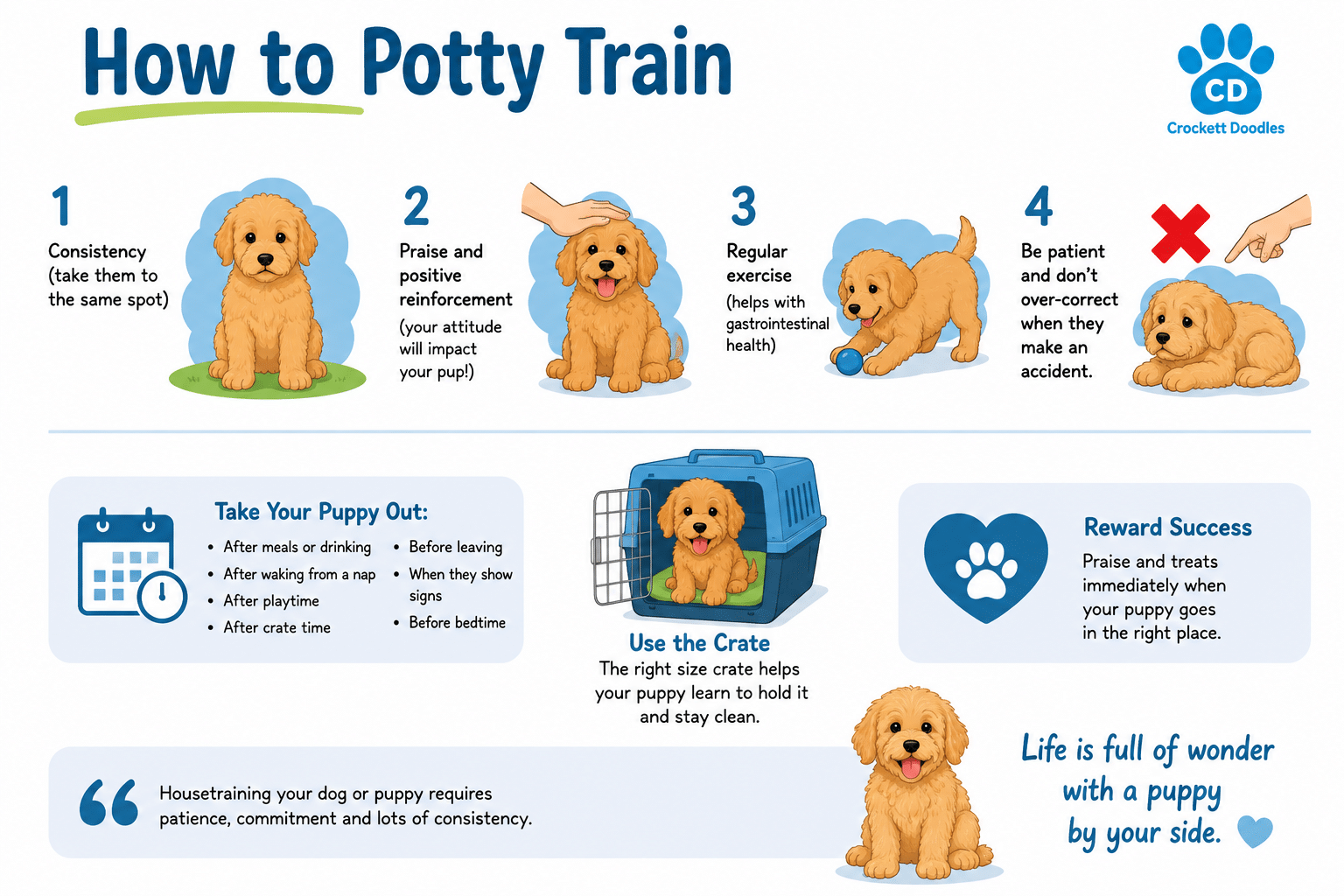
“Housetraining your dog or puppy requires patience, commitment and lots of consistency.”
When Should You Start Potty Training a Puppy?
You should start potty training your puppy as soon as they come home. Young puppies may not yet have enough bladder and bowel control to stay accident-free for long periods, but they can still begin learning where you want them to go.
This is different from expecting a very young puppy to reliably “hold it” for several hours. At this age, successful potty training is mostly about preventing accidents, creating a routine, and giving your puppy frequent chances to succeed.
Some trainers use a puppy’s age in months plus about one hour as a rough estimate of how long an older puppy may sometimes be able to hold their bladder. This should never be treated as a guaranteed schedule. Young puppies often need much more frequent bathroom breaks when they are awake, active, eating, drinking, or playing.
Establish a Consistent Potty Training Routine
A regular routine is one of the most useful tools for house training. Puppies often need to eliminate after predictable activities, so planning bathroom breaks around those moments can prevent many accidents.

Take your puppy outside:
- First thing in the morning
- Shortly after meals or drinking
- After waking from a nap
- After active play
- After spending time in the crate
- Before you leave your puppy alone
- As soon as you return
- Whenever your puppy shows signs they need to go
- Before bedtime
Regular meal times can also make your puppy’s bathroom routine easier to predict. Follow the feeding schedule recommended for your puppy rather than constantly changing meal times.
Watch your puppy closely between scheduled trips. Common signs that a puppy may need to eliminate include sniffing the floor, circling, pacing, whining, becoming restless, suddenly wandering away, or heading toward a familiar exit.
If you notice one of these behaviors, take your puppy to the potty area right away. An unnecessary trip outside is usually better than an accident indoors.
Smaller puppies may need more frequent opportunities than larger puppies, but size alone cannot tell you exactly how long a dog can wait. Age, activity, meals, water intake, health, and the individual puppy all matter.
Use the Same Potty Area
Taking your puppy to the same outdoor area can help establish a familiar bathroom routine. Previous scent in the area may also make it easier for your puppy to understand what you are asking them to do.
Keep bathroom trips calm and focused. Give your puppy enough time to sniff and settle rather than immediately turning the trip into playtime.
You can also introduce a simple verbal cue such as “go potty.” Say it calmly as your puppy begins to eliminate. With repetition, your puppy may learn to associate the phrase with the behavior.
When your puppy finishes in the correct place, reward them immediately with praise, a small treat, or another reward they enjoy. Immediate reinforcement helps your puppy connect going potty outside with a positive result.
If you want your puppy to use one particular part of your yard, take them directly to that location each time. A pet-safe potty attractant or an appropriate training pad may also be useful in some situations. Avoid using strong household chemicals to encourage elimination.
Using a Crate to Support Potty Training

A crate can be a helpful house-training tool when it is introduced positively and used appropriately. Dogs generally prefer not to eliminate where they sleep, so a properly sized crate can help your puppy develop a predictable bathroom routine.
The crate should provide enough room for your puppy to stand, turn around, and lie down comfortably. It should not be so large that the puppy can routinely use one end as a bathroom while sleeping at the other end. A divider can help adjust a larger crate as your puppy grows.
A crate should never be used to make a puppy hold their bladder longer than they are physically capable of doing. Very young puppies need frequent breaks, and some may need an overnight bathroom trip.
If your puppy repeatedly eliminates in the crate, review the schedule and make sure they are getting enough opportunities to go outside. Frequent crate accidents can also occur because of digestive problems, urinary issues, stress, or another health concern. Talk with your veterinarian if accidents are unusually frequent, suddenly increase, or are accompanied by other symptoms.
For a more detailed introduction to the crate itself, see our guide to crate training your puppy.
What Should You Do When Your Puppy Has an Accident?
Do not punish your puppy for a potty-training accident. Accidents are a normal part of learning, especially with a young puppy that has limited bladder control.
If you discover an accident after it happened, simply clean it thoroughly. Scolding your puppy, rubbing their nose in the mess, or taking them back to the accident will not teach them what you wanted them to do.
If you catch your puppy starting to eliminate indoors, interrupt calmly and take them to the correct potty area. Avoid frightening them with yelling or a loud startle. If they finish outside, praise and reward them.
Reward-based training is safer and more useful than punishment for teaching desired behavior. Punishment can create fear or cause a puppy to avoid eliminating when you are nearby instead of teaching them the correct location.
Clean accident areas thoroughly with a pet-safe enzymatic or odor-neutralizing cleaner. Lingering odors may encourage a puppy to return to the same area. You can find other practical preparation items on the Puppy Shopping List.
How Long Does Puppy Potty Training Take?
There is no exact age when every puppy becomes fully potty trained. Some puppies establish reliable habits fairly quickly, while others may need several months of consistent supervision and reinforcement.
Progress may not be perfectly steady. A puppy can seem reliable for several days and then have another accident, especially after changes in schedule, excitement, travel, illness, or being given more freedom in the house.
Do not expand your puppy’s access to the home too quickly. Supervise them closely until they consistently understand where to eliminate. When you cannot supervise, an appropriately introduced crate or another safe puppy area can help prevent mistakes.
The goal is not to demand perfect bladder control from a young puppy. Your job is to create enough successful repetitions that going outside gradually becomes the puppy’s normal habit.
Keep the Routine Consistent
Potty training becomes much easier when everyone in the household follows the same routine. Use the same outdoor area when practical, respond to your puppy’s signals, take them out after predictable activities, and consistently reward success.
Your puppy is still learning how your household works. Patience during the first weeks can help establish habits that make daily life easier later.
Families who would like a head start can review Crockett Doodles’ Puppy Training programs. Crockett Doodles currently offers training options that can include an introduction to potty training and a dedicated Board & Potty program. Training provides a foundation, but continued consistency at home is essential for long-term progress.
For more help preparing for life with a new puppy, the Puppy Start Guide covers several parts of the transition home. Families who need personalized training guidance can also use Ask a Trainer.


